If you’re a parent thinking, “That’s great! I can know exactly when my child leaves the house or yard,” that is where you are wrong. That is not how geofencing ends up working in practice, especially not with kids smartwatches.
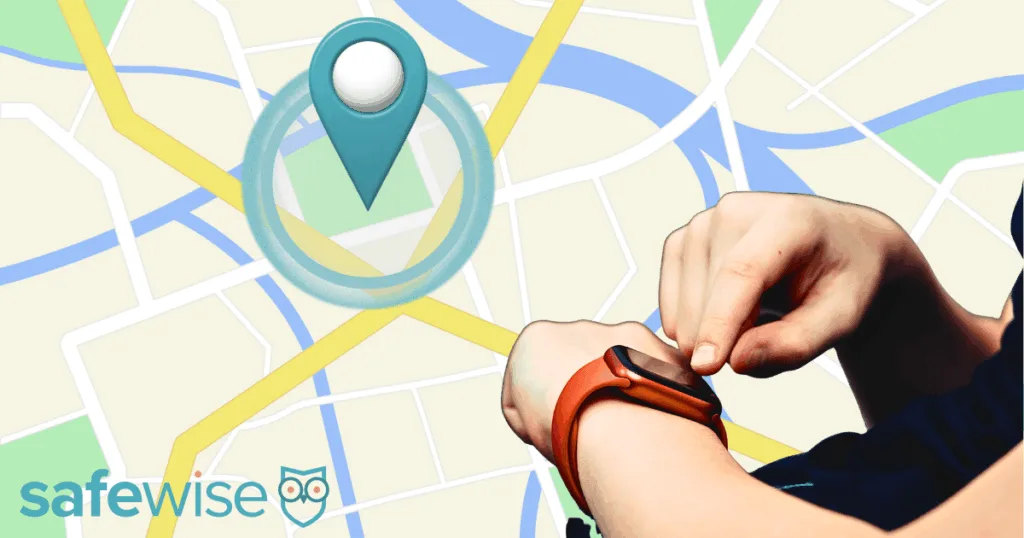
In reality, there is a rather large minimum boundary that you have to deal with. With some kids smartwatches, the minimum boundary is a radius of around 700 feet. That is a huge circle. When I was testing it in my neighborhood, it covered about a block to a block and a half.
Kids smartwatches have those large boundaries because they're trying to reduce false alarms. GPS tracking is only accurate to about 16 feet, which means you are not guaranteed to always get a precise location.
I live in an area where houses are about five feet away from each other. So 16 feet means I might get a notification saying my child is at the neighbor’s house or across the street, even when they are just in the next room. If I set up a geofence that was really small and only covered my property line, I would be getting false alarms constantly.
I also take issue with the fact that geofence boundaries in kids smartwatches are always circles. It might seem like a minor detail, but when there is a minimum boundary of about 700 feet, and I want my house at the center so I know any time my child goes 700 feet in any direction. But, where I live, 700 feet to the east would put them in the middle of a river. I would definitely want a notification before my child gets anywhere near that river.
If I adjust the boundary further west to compensate, that means my child can get farther west before I receive a notification. It becomes difficult to set boundaries when all you have to work with is a circle. As far as I know, no kids smartwatch allows you to draw custom boundaries using lines, although I have seen that feature in regular GPS trackers, so I know it is possible.
Another issue I have with geofencing is how some companies set up their notifications. I think most parents expect to get an instant notification when their child crosses a geofence boundary. However, some kids smartwatches don't provide instant notifications. Instead, they tie geo fence alerts to the normal location update schedule, which completely defeats the purpose of immediate alerts.
Here's what I mean. Let's say you have a watch set to update its location every 10 minutes and, for the sake of argument, those updates happen on the hour, at ten past, twenty past, etc. At the 2:00 update, your child was inside the geofence boundary, so you don't get an alert. But at 2:01, they crossed the virtual line. You get notified nine minutes later at 2:10, when the next location refresh happens.
Slight delays can also occur with smartwatches that don't tie geofencing notifications into the location refresh schedule.
What does this mean for you and your children? If your child has a serious elopement risk and could endanger themselves by getting away from home even a little bit, this is not reliable or strong enough technology to keep them safe on its own. Consider using door chimes with loud alerts that the whole house can hear instead of relying solely on geofencing and a smartwatch. Geofencing can be one layer, one tool in your toolbox, but it is not something I would rely on exclusively. There are too many things that could go wrong with notifications or accuracy.
For everyday use, like making sure your child leaves school at the right time, goes to the correct friend’s house, or does not make unexpected detours on the way to the park, geofencing can be a helpful tool. You just need to be prepared for false alarms and understand that this is not perfect technology.



 5 min read
 Reviewed By