



Life Alert Systems Review

We dug through customer reviews and spoke with a Life Alert rep to get a feel for this company. Proceed with caution.
Life Alert
2 out of 5 stars
2
Monitoring starts at$69.95/mo
  • pro
    2-way communication
  • pro
    Insured equipment
  • con
    Pushy sales

Info current as of post date. Offers and availability may vary by location and are subject to change.

Why you can trust SafeWise
products considered
250+
research hours in 25+ in-home tests
10k+
years of combined experience
176+
homes and people protected
10M+

For over 13 years, SafeWise experts have conducted independent research and testing to write unbiased, human reviews (not robots). Learn more.

Cathy Habas
May 27, 2026
Icon Time To Read6 min read

Cathy has been researching and writing about safe aging since 2021. She holds a certificate in gerontology and is one of the internet's most knowledgeable voices in senior safety tech. Her work takes a hands-on, empathetic approach.

Icon Bell  Dark
Are you on the right page?

A lot of people search for Life Alert (a brand) when they really want to learn about medical alert systems (a type of product). So before we go any further, we want to make sure you're in the right place:

  • Do you want our opinion on medical alerts in general? If so, head to our best medical alerts round-up.
  • Are you here to learn about Life Alert specifically? Great! Keep scrolling. 

Life Alert sells the most expensive medical alert devices on the market and offers just the basics. We can count its advantages on one hand — namely its long-lasting batteries and reputation for speedy, professional service once the help button is pressed. 

The disadvantages of Life Alert include its high price, 3-year contract, lack of fall detection, and lack of a caregiving app. 

Some people really like this brand, but it's not right for everyone. This review will help you know what to expect so you can make an informed decision for yourself or a care partner. 

pro
Pros
pro 30+ years in business
pro Insured equipment
pro Long-lasting batteries
pro Five Diamond-certified monitoring center
pro Wall button with 2-way talk
con
Cons
con Hidden prices and fees
con 3-year contract
con Pushy sales
con No fall detection
con No caregiver features
con Phone ordering only

What does Life Alert do?

Life Alert sells wearable buttons that connect to a 24/7 monitoring center when pressed during an emergency. Most of Life Alert's equipment is meant to be used inside the home or in the yard, but the company does sell a mobile system that can be used anywhere. 

Some of Life Alert's highlights include:

  • Two-way talk in most devices
  • Batteries that last for years without charging 
  • A waterproof wall button and waterproof wearables
  • A reputation for fast, reliable service

Life Alert doesn't offer some popular medical alert features, including:

How much does Life Alert cost?

Life Alert costs more than any other medical system. The at-home system alone costs $69.95 per month and requires a 36-month contract. That's double the cost of other in-home systems, most of which offer month-to-month contracts.

Expect to pay at least $248 in equipment fees as well. However, this doesn't mean you own the system. You'll need to return it when your contract ends.

Note that you can't buy Life Alert online. You must call a sales rep to make a purchase. This makes it difficult for us to confirm that prices are standardized throughout the country. You may receive a quote that's different from ours. 

Compare monitoring fees for each device

Equipment
Monthly cost
Equipment fee
Estimated 12-month cost
Estimated 36-month cost
$248.00$1,087.40$2,766.20
$248.00$1,327.40$3,486.20
$248.00$1,327.40$3,486.20
$248.00$1,327.40$3,486.20
$0$240$720

Info current as of post date. Offers and availability may vary by location and are subject to change.

How does Life Alert compare to other medical alert brands?

Compared to other medical alert brands, Life Alert ...

  1. Is more expensive
  2. Requires a long-term contract that's difficult to cancel
  3. Doesn't offer fall detection or caregiver features
  4. Has better two-way talk in at-home devices
  5. Has better battery life in an on-the-go device

1. Life Alert is more expensive

Life Alert is more expensive and requires a longer  commitment than other medical alert systems. Other popular brands like Bay Alarm Medical and Medical Guardian don’t require a contract, have starting rates half the cost of Life Alert, and offer more equipment.

We encountered other services, like GetSafe, that require one-time equipment fees like Life Alert, but it’s a rare feature. The monthly cost you pay Bay Alarm Medical and Medical Guardian goes towards the professional monitoring service rather than the equipment.

2. Life Alert requires a 3-year contract that's tough to cancel

Life Alert is the only major medical alert company that requires a long-term contract. You sign up for a 3-year service plan with Life Alert. You get a price lock guarantee for the duration of your contract, but the price may go up upon renewal. Companies like Bay Alarm Medical and ADT Medical Alert offer price lock guarantees with no contracts.

Cancelling Life Alert is notoriously difficult. You can't cancel your contract without proof that the user has been moved into a nursing home or assisted living facility, receives 24-hour in-home care, or has died. You need to be near the device when cancelling in order to deactivate it, and Life Alert only accepts cancellation orders from the payer or someone with power of attorney for the payer.

3. Life Alert doesn't offer fall detection or caregiver features

Life Alert doesn't offer automatic fall detection — which is ironic for a medical alert company that's famous for the phrase "I've fallen and can't get up."

Fall detection is common add-on in medical alert systems that detects speed and pressure changes that happen when a person falls. These medical alert devices automatically contact an emergency responder if you’re unconscious or can’t reach your call button.

Life Alert also isn't designed with caregivers in mind. There's no Life Alert app caregivers can use to track their loved one's location, help pay bills, or coordinate with other caregivers.

4. Life Alert has better two-way talk in at-home devices

On the plus side, Life Alert is the only company to offer two-way talk in wall buttons and at-home buttons, so it could be a good choice for people who are hard of hearing or have a larger home. Otherwise, it can be tough to speak through an at-home base station if you've fallen outside or in another room.

5. Life Alert has better battery life in an on-the-go device

The other major perk is that Life Alert's mobile system doesn't need to be charged. People can be vulnerable when their medical alert systems are being charged, so this could be a good option if you're concerned about losing protection, especially at night.  

Learn more about our recommended Life Alert alternatives.

Compare Life Alert to other medical alert companies

Brand
Lowest monthly price
Lowest equipment price
Contract length
Fall detection
Learn more
Read review
$248.0036 mo.
Icon No  LightNo
Included in plan Month to month
Icon Yes  LightYes
$79.00 Month to month
Icon Yes  LightYes
Included in plan Month to month
Icon Yes  LightYes
Included in planMinimum 3-month commitment
Icon Yes  LightYes

Info current as of post date. Offers and availability may vary by location and are subject to change.

A closer look at Life Alert products

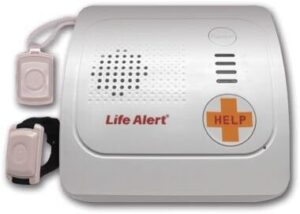
Life Alert sells two types of medical alert devices or personal emergency response systems (PERS): an at-home system and an on-the-go system. The at-home system features several upgrades, including a pendant or wristband with two-way talk and a waterproof help button that attaches to the wall. 

Image: Life Alert

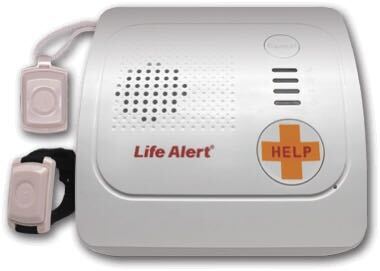
At-Home System

  • Landline and cellular options
  • 72-hour backup battery
  • Button can be worn as pendant or bracelet
  • Pendant works up to 800 feet from base station
  • Pendant batteries last up to 10 years

Image: Life Alert

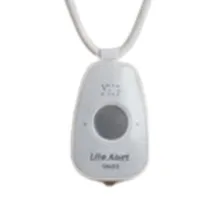
Micro Voice Pendant

  • Doesn't need charging
  • 2-way talk
  • Water-resistant
  • Must be bundled with At-Home base station
  • Works up to 1,000 feet from base station

Image: Life Alert

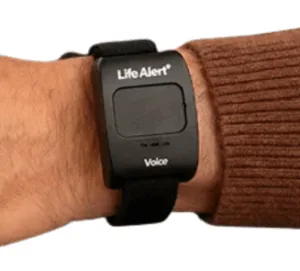
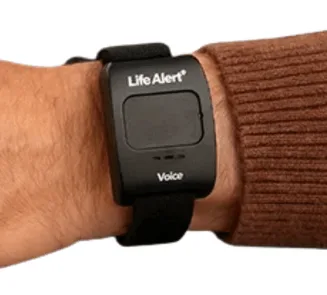
Wristband button

  • Doesn't need charging
  • 2-way talk
  • Water-resistant
  • Must be bundled with At-Home base station
  • Works up to 1,000 feet from base station
Life Alert button

Image: Life Alert

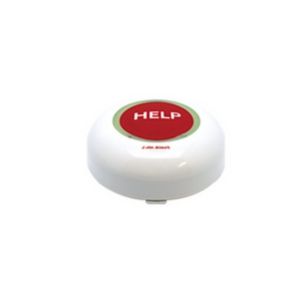
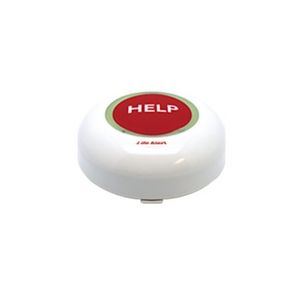
Wall button

  • Cellular
  • 10-year battery
  • 2-way talk
  • Water-resistant
  • Must be bundled with At-Home base station

Image: Life Alert

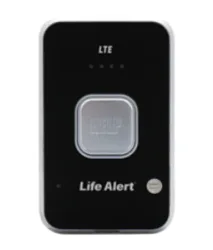
On-the-Go with GPS

  • Cellular
  • 10-year battery
  • 2-way talk
  • GPS location not available to caregivers
  • No fall detection

Does Life Alert have good customer service?

Overall, Life Alert has earned a customer rating of 4.9 out of five stars from more than 12,050 reviews, making it the highest-rated medical alert system on the market. However, many people leave reviews after speaking to a sales representative, so it's tough to know how people feel after using the system. 

We've been unable to test Life Alert’s emergency response hands-on, so we turned to customer testimonials and reviews. From what we found, Life Alert is genuinely helpful in an emergency. We saw stories of subscribers able to get help in time after emergencies like falls and chest pain.

Complaints usually center around cancellation difficulties. Life Alert requires the payer to be the one who cancels, and sometimes that can be difficult if the payer isn't feeling well. Life Alert also requires documentation that other medical alert systems don't ask for when cancelling. If you need to cancel before the 36-month contract is up, you need to pay the remaining amount on the contract. 

Watch for pushy sales tactics if you aren't ready to buy

We called Life Alert to get more information about the products, policies, and prices an average customer could expect.

Before we got to ask any questions, we had to provide information to get a free brochure (which we weren’t entirely interested in). Once we got in touch with a sales rep, they were pushy and barely gave us time to ask questions. The rep we spoke to used guilt tactics, dodged direct questions, and ran verbal circles around us. After only 20 minutes on the phone, we were exhausted.

Icon Quote  Dark
What real Life Alert customers are saying
"After the rigmarole of getting signed up and receiving/setting up the products, Life Alert was great. The first year, my mom fell several times and pressed her necklace button. The paramedics came quickly, and I was thrilled with the products and services.

"Then, Mom had stroke #3 and became too confused to remember to use the necklace button. I attempted several times to cancel Life Alert and asked for an address to return the equipment, but to no avail. It sat unused for nearly a year."

Life Alert FAQ

No, none of Life Alert’s equipment comes with a fall detection add-on. Fall detection can contact emergency services in the event of a fall or accident where you cannot reach your pendant.

See our recommended medical alert systems with fall detection.

Yes, Life Alert’s wearable pendant, wall button, and GPS device are all waterproof.  

Life Alert's cellular devices connect to the AT&T network. You don't need a separate AT&T account to use Life Alert, but you do need to live in an area with good AT&T cellular coverage. A landline option is available if you don't have good coverage. 

How we reviewed Life Alert

Before writing our Life Alert review, we started by digging through its website and customer reviews from other sites. We also called Life Alert directly.

Once we reached a customer service rep, we took note of how they answered, what they said, and how satisfied we were with their answers.

It's cost-prohibitive for us to buy a Life Alert system for testing. We have reached out to Life Alert to ask if they would temporarily send us equipment to test its performance. We'll update this review if we hear back. 

Learn more about how we review medical alert systems and other safety products in our full methodology.

Is Life Alert right for you?

Life Alert is quick in an emergency and has equipment with some helpful features, but these are standard for a typical medical alert system. The only thing to get excited about is two-way talk in the at-home wearable and wall button, as no other medical alert systems offer this feature in at-home devices that don't need to be charged.

But the pushy sales, lack of fall detection, and sky-high prices eclipse most of Life Alert’s best features.

We’d like to see some modernization in the form of a caregiver app, transparent pricing, and the ability to buy a system online.

While we don’t recommend Life Alert for many people, you can read about the companies we do recommend as the best medical alert systems.

Cathy Habas
Written by
With over 12 years of experience as a content writer, Cathy has a knack for untangling complex information. Her natural curiosity and ability to empathize help Cathy offer insightful, friendly advice. She believes in empowering readers who may not feel confident about a purchase, project, or topic. Cathy earned her Bachelor of Arts degree in English from Indiana University Southeast and began her professional writing career immediately after graduation. She has focused on family safety, home guides, and health content since 2021 and earned a gerontology certificate to learn more about the medical side of senior safety. Over the years, Cathy has contributed to sites like SELF.com, SingleCare, My Health Teams, Safety.com, Reviews.com, Hunker, Popular Living, and Thumbtack.

Recent Articles

Eufy camera 3 with solar panels built in the top, sitting on a wooden counter
Best Security Cameras without a Subscription 2026
Paying a monthly fee for a security camera isn't easy on your wallet. Based on...
ring spotlight camera on outdoor wall
Ring Camera Storage Plans
Ring Protect is a great option for saving video from Ring security cameras. Learn about...
elderly-woman-checking-watch-on-bench
4 Best GPS Trackers for Dementia Patients (2026 Review)
GPS tracking can help caregivers watch loved ones with dementia and prevent wandering. We reviewed...
dark brick porch with light from decorative porch light
A Guide to Porch Light Safety: Leave It On or Turn It Off?
What does leaving the porch light on mean? And when should you turn it off?...