

2026 Special Report: Immigration Enforcement & Community Safety Perception
years of comparative data
7
Americans surveyed per state
100
total responses per year
5,000
questions fielded in 2025
34
For over 13 years, SafeWise experts have conducted independent research and testing to write unbiased, human reviews (not robots). Learn more.

 7 min read
 Reviewed By
This pulse survey captures how immigration enforcement is being experienced not just as policy — but as a community safety issue.
Executive summary
Recent national events and heightened media attention around immigration enforcement have intensified public conversation about safety across the United States.
To understand how Americans currently perceive immigration enforcement activity — and how those perceptions may be shaping daily life — we conducted a national pulse survey of 1,250 U.S. adults in February 2026.
This survey reveals clear differences between how concerned Americans were in August 2025, when we fielded our annual State of Safety survey, and how they feel today.
The findings reveal elevated concern, nuanced views of safety, and measurable — though selective — behavior change.
Key findings
- 62% of Americans report elevated concern (5–7 on a 7-point scale) about immigration enforcement activity.
- A plurality — 44.6% — say enforcement makes their community feel less safe, compared to 35.1% who say it makes their community feel safer.
- More people say enforcement makes communities feel less safe than safer. (Net safety perception is –9.4 points)*
- 1 in 2 said that immigration enforcement activity has occurred in or near their community in the past 12 months.
- Nearly one-third (31.8%) report changing daily behavior due to enforcement-related concerns.
- Top concerns center on community tension, risk of violence, and mistaken identity, rather than economic or political factors.
- People who are more aware are also more likely to be concerned: 65.3% report high awareness of enforcement activity, suggesting a potential link between anxiety and public information.
Taken together, the data suggest that immigration enforcement is now widely perceived as a safety-relevant issue — though not one that drives most people to change their daily behavior.
*Net perception values reflect the directional difference between opposing responses (e.g., % less safe minus % safer), not a composite safety score.
How concerned are Americans about immigration enforcement?
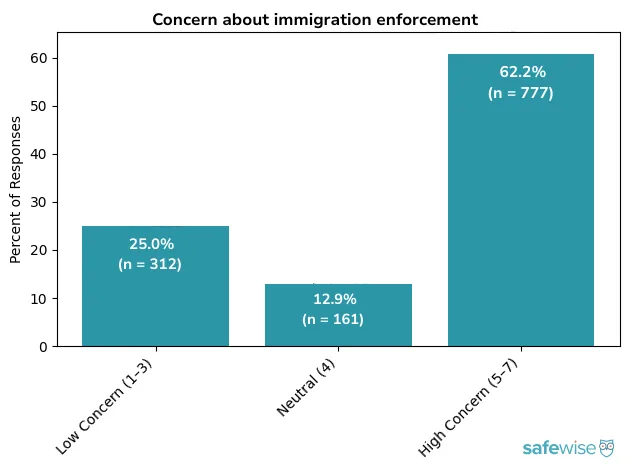
When asked how concerned they are about immigration enforcement in February 2026, the majority of Americans reported high concern. Perception data; not crime rates. Image: SafeWise, Immigration pulse survey, Q5: Using a scale from 1–7, how concerned are you about current ICE or immigration enforcement activity?
Context: From State of Safety to pulse survey
In the 2026 State of Safety report (fielded August 2025), SafeWise's annual safety sentiment and behavior survey, 5,000 Americans were asked about their level of concern around immigration specifically, not immigration enforcement:
- 4% of Americans cited immigration as their single biggest safety concern in open-ended responses.
- 56% reported concern when immigration was compared against other national issues.
In early 2026, amid increased visibility of immigration enforcement activity and public debate, we fielded this pulse survey to assess whether public safety perceptions had shifted.
When asked the same question about concern over immigration compared to other national issues, 60.56% reported concern — an 8% increase. Those who reported high concern remained steady, with just over 30% of respondents highly concerned in February 2026 and 29% in August 2025.
Although general concern about immigration as a broad issue has remained relatively stable, the pulse survey results indicate that enforcement activity — distinct from immigration broadly — is now a primary source of concern for a majority of Americans.
Concern about social and political issues in the U.S.
Source: SafeWise 2026 State of Safety survey, August 2025
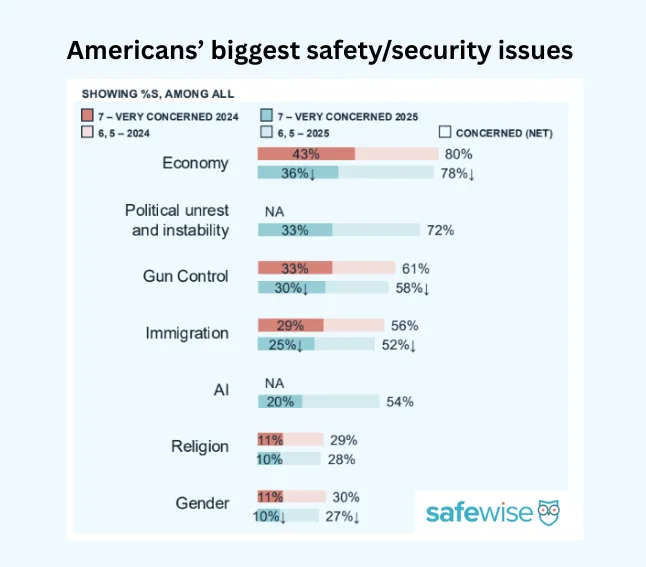
The social and political issues that Americans are most concerned about. Immigration (broadly) ranked fourth among the most concerning issues, behind the economy, political unrest, and gun control. In our pulse survey, immigration ranks third, and gun control dropped to fourth. Image: SafeWise State of Safety report, B10. Using a scale from 1 to 7, where ‘1’ is not at all concerned and ‘7’ is very concerned, how concerned are you about the following issues? Among all, 5000n.
National findings
1. Elevated concern is widespread
When asked how concerned people are about current ICE or immigration enforcement activity:
- 62.2% report high concern (5–7)
- 36.3% selected “Very Concerned”
- 25.0% report low concern
- 12.9% report neutral concern
Takeaway: Concern is concentrated at the high end of the scale, indicating that this isn’t a fringe response.
2. Enforcement & community safety: A plurality see risk
Respondents were asked whether immigration enforcement makes their community feel safer or less safe:
- Less safe: 44.6%
- Safer: 35.1%
- No real impact: 20.3%
This produces a –9.4 point net safety perception (the share who say enforcement makes their community feel less safe minus the share who say it makes their community feel safer).
Takeaway: While views are divided, more people say enforcement makes their community feel less safe than safer. Notably, one in five say it has no real impact — suggesting normalization or uncertainty rather than overwhelming alarm.
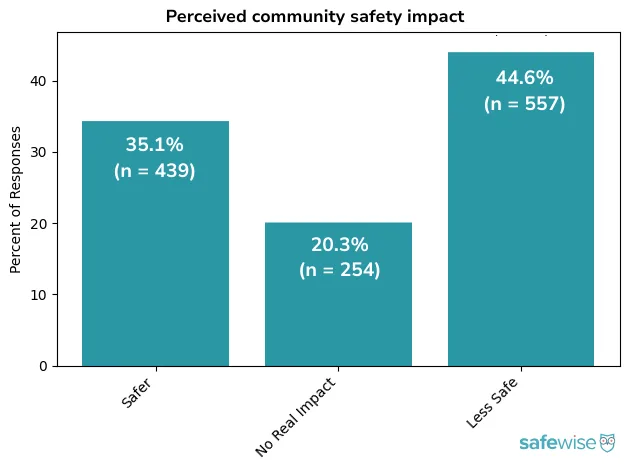
Almost 45% of respondents said immigration enforcement made their community less safe, versus 35% who thought it made their community safer. Two in ten don't think it has any impact. Image: SafeWise, SafeWise immigration pulse survey, Q7. Overall, do you think immigration enforcement activity makes your community safer or less safe?
3. Awareness & concern move together
Concern closely tracks awareness:
- 65.3% report high awareness of enforcement activity
- 62.2% report high concern
Takeaway: A lack of awareness about what's happening isn't what's driving public concern. In fact, those who are up-to-date on enforcement activity were more likely to report higher concern. This suggests people’s concerns are grounded in what they’re seeing and experiencing, not a lack of information.
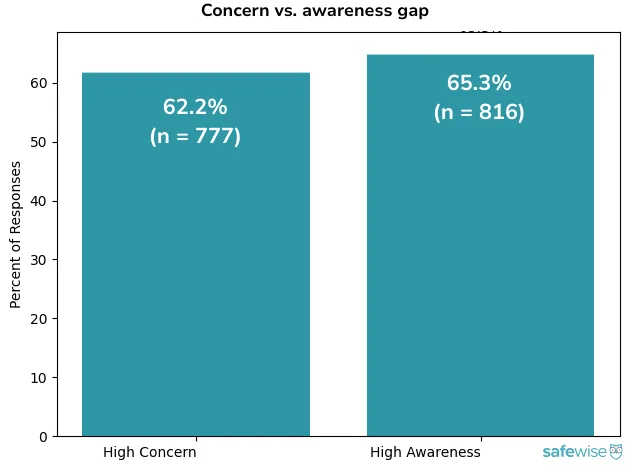
People who have more awareness of immigration enforcement activities also reported higher concern. Image: SafeWise, SafeWise immigration pulse survey, Q3. How aware are you of recent ICE or immigration enforcement activity in the U.S.?
4. The anxiety–action gap
Despite elevated concern:
- 31.8% report changing daily behavior
- 10.9% significantly
- 20.8% somewhat
- 63.5% report no behavior change
Takeaway: Although concern is widespread, not everyone is changing their behavior. Most Americans are going about their regular routines — despite reporting rising anxiety.
This reflects a pattern seen in other safety domains: psychological concern often outpaces lifestyle change. It could also indicate that motivation to change behavior may correlate to how much enforcement activities directly impact individuals on a daily basis.

Insight: Real experiences related to immigration enforcement
While nearly 4 in 10 (38.2%) respondents reported no experience with immigration enforcement, almost 1 in 10 have had a direct interaction with ICE or immigration authorities. Here's what people reported:
- Attending a community protest or demonstration: 18.3%
- Observing an increased law enforcement presence: 14.5%
- Detention/arrest, or detention/arrest of someone they know: 9.8%
- Direct interaction with ICE or immigration authorities: 8.6%
- Property search or siezure: 7.2%
SafeWise immigration pulse survey, Q8. Have you or anyone you personally know experienced any of the following related to immigration
enforcement?
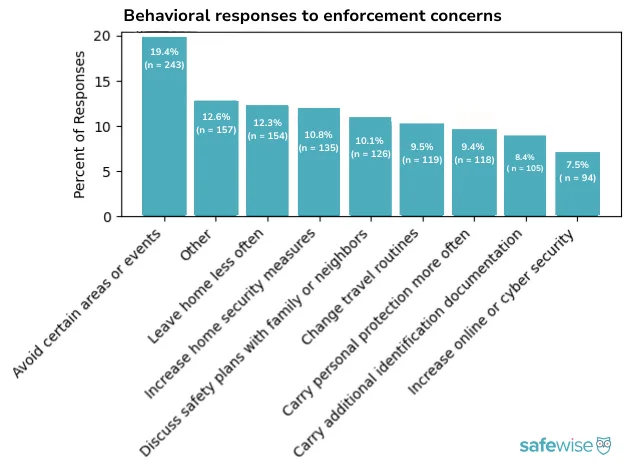
Among those who reported behavior changes due to their concern around immigration enforcement, avoidance behavior was more common than increasing security or other defenses. Image: SafeWise, SafeWise immigration pulse survey, Q11. Has concern about immigration enforcement activity caused you to change your daily behavior? Q12. What actions have you taken as a result?
5. What Americans fear most
Top reported concerns related to enforcement activity:
- Community tension or unrest: 18.9%
- Risk of crime or violence: 17.6%
- Mistaken identity or wrongful detention: 13.9%
- Personal safety: 12.6%
- Only 5.6% selected “I am not concerned.”
Takeaway: The dominant fears around immigration enforcement are community and violence-oriented. Americans are expressing concern about instability and conflict more than about enforcement errors (though that is still represented).
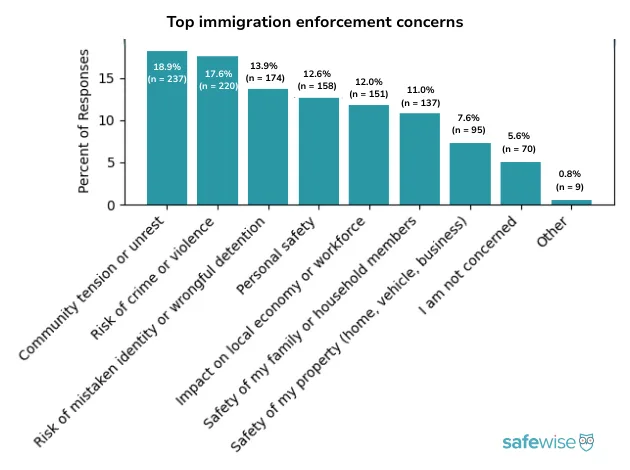
Community unrest and the risk of crime or violence are more concerning than things like property damage in response to enforcement activities. Image: SafeWise, SafeWise immigration pulse survey, Q6. What, if anything, are you concerned about related to immigration enforcement activity?
6. National safety perception: Mixed but cautious
When asked how immigration, overall, affects U.S. safety:
- Safer: 27.6%
- Less safe: 42.9%
- No impact: 29.5%
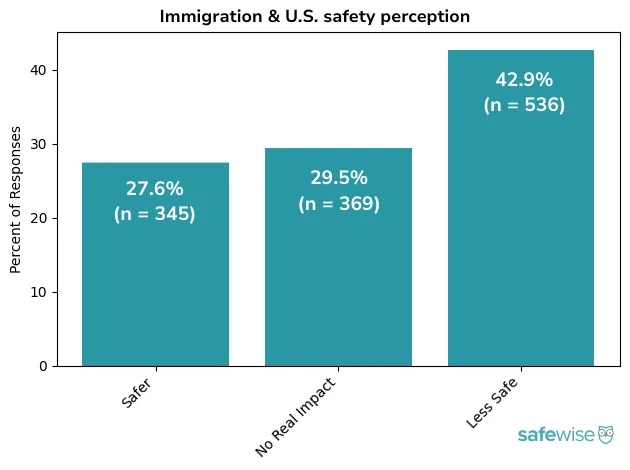
About 4 in 10 respondents think immigration, in general, makes the U.S. less safe, but around 3 in 10 think it has no real impact. Image: SafeWise, SafeWise immigration pulse survey, Q19. Overall, how do you think immigration affects safety in the United States?
7. Concern has risen year over year
Compared to last year, are Americans more or less concerned about immigration enforcement activity:
- More concerned: 47.7%
- About the same: 38.1%
- Less concerned: 14.2%
Takeaway: More Americans are worried about immigration enforcement than last year — but for most people, concern hasn’t changed much, and only about one in seven report feeling less concerned.
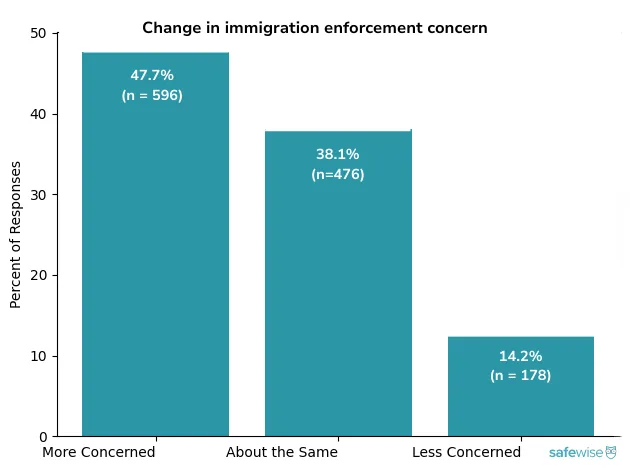
Nearly 1 in 2 respondents said they were more concerned about immigration enforcement in 2026 than they were in 2026; however, nearly 4 in 10 reported no real change in their level of concern. Image: SafeWise, SafeWise immigration pulse survey, Q17. Compared to last year, are you more or less concerned about immigration enforcement activity?
State-level callouts
State-level findings reflect reported perceptions, not objective measures of safety or enforcement activity, nor definitive statewide population estimates.
These findings offer a snapshot of where concern and behavior change are highest (and where they're lower) rather than a definitive ranking of state-level risk.
How people view immigration enforcement and safety varies widely by state — and not always in the ways you’d expect. Border states and places with high-profile enforcement activity aren’t always the ones seeing the biggest shifts in concern or behavior.
Highest reported concern:
- West Virginia: 84%
- Minnesota: 76%
- California: 76%
- Virginia: 76%
Lowest reported concern:
- Vermont: 42%
- South Dakota: 44%
- Iowa: 44%
States most likely to say enforcement makes communities feel less safe:
- Virginia: 64%
- Minnesota: 60%
- West Virginia: 56%
- New Mexico: 56%
States reporting the most behavior change:
- California: 56%
- West Virginia: 44%
- Minnesota: 44%
- Illinois: 44%
- New Mexico: 44%
Takeaway: Concern doesn’t map cleanly to geography or proximity to borders. Elevated anxiety shows up across diverse regions, suggesting visibility and local context matter more than location alone.
The big picture
This pulse survey reveals a complex and nuanced public response to immigration enforcement:
- Concern about enforcement is now mainstream.
- More people say enforcement makes communities feel less safe than safer.
- Awareness and concern move together.
- Some people are changing how they move through daily life — but most aren’t.
Fear centers on instability and error, not on politics alone.
Rather than polarization, the data point to uncertainty.
Americans are paying attention, and they're concerned. But most people are still going about their daily lives — with more awareness, but not dramatically changing how they live.
Methodology
This survey was conducted on February 19, 2026, among 1,250 U.S. adults using mobile-based sampling.
- Nationally distributed sample: 25 respondents/state
- Margin of error: approximately ±2.8 percentage points at the 95% confidence level
- Some subgroup and state-level findings have higher margins of error due to smaller sample sizes
- All results reflect self-reported perceptions, not verified incidents or official statistics
About this report
This study is a supplemental analysis to SafeWise’s 2026 State of Safety report and reflects evolving public sentiment amid heightened national discussion around immigration enforcement and community safety.
The goal of this research is to better understand how Americans perceive safety — and how those perceptions shape behavior — during periods of increased visibility and public debate.
Media note: Findings reflect reported perceptions at a point in time and should not be interpreted as measures of actual crime rates or enforcement activity.
Coming next: Community Impact & State Context Analysis
Rebecca Edwards
Managing Editor & Lead Safety Expert
Rebecca is the Managing Editor and Lead Safety Expert at SafeWise, where she oversees the editorial direction, accuracy, and interpretation of SafeWise’s original safety research. She specializes in crime trends, home and personal security, and translating complex safety data into clear, trusted insights for consumers, media, and policymakers.
Cathy Habas
Senior Writer, Family Safety & Data Projects
Cathy is a Senior Writer at SafeWise, focusing on family and personal safety, as well as data-driven research projects. Her work contributes to SafeWise’s annual reports and special studies, helping contextualize survey findings and safety trends for households and families across the U.S.
Daniel Delgado
Data Analyst, SafeWise
Danny is a data analyst at SafeWise, supporting the collection, analysis, and interpretation of proprietary survey data and crime trends, as well as external crime and safety data and trends. His work contributes to the State of Safety report, Safest Cities rankings, and ongoing state- and city-level safety analysis.
Ben Stickle, PhD
Criminologist & Expert Adviser/Reviewer
Dr. Ben Stickle is a criminologist and professor whose research focuses on crime trends, criminal behavior, and public safety. He serves as an expert reviewer for SafeWise’s safety research, providing subject-matter expertise and guidance on interpreting crime-related findings.


Recent Articles

The Best Fall Detection Devices
Find the best medical alert systems with fall detection. Compare equipment, price, accuracy, customer reviews,...

Jury Finds Meta and YouTube Negligent in Landmark Social Media Addiction Case
Meta and YouTube were found negligent in a landmark addiction case. Here’s why it matters...
How Safe Are the Fastest-Growing U.S. Cities?
Does a surge in population lead to a surge in crime? Find out in our...
Package Theft and Cybercrime Are Now the Most Common Crimes in America
State of Safety data shows Americans are more likely to experience package theft and cybercrime...


