

Medical Guardian excels at both at-home and mobile medical alert systems, but premium features come at a higher price.
Medical Guardian Review



Why you can trust SafeWise
products considered
250+
research hours in 25+ in-home tests
10k+
years of combined experience
176+
homes and people protected
10M+
For over 13 years, SafeWise experts have conducted independent research and testing to write unbiased, human reviews (not robots). Learn more.


 9 min read
In our years of hands-on testing and mystery shopping, Medical Guardian always stood out as an innovative medical alert system. Its device roster is frequently updated to include new systems with the latest tech and impressive features, while remaining user-friendly.
In this honest review, we’ll take a closer look at each Medical Guardian system. We’ll break down cost, features, and who we recommend it for. We’ll also see how the brand stacks up against its biggest competitors.

Pros
 Landline and cellular options
32+ hour backup battery in base unit
Industry-leading 1,400-foot range
No activation fee
Five Diamond Certified monitoring center
Free pendant battery replacement
Discounted spouse coverage
Landline and cellular options
32+ hour backup battery in base unit
Industry-leading 1,400-foot range
No activation fee
Five Diamond Certified monitoring center
Free pendant battery replacement
Discounted spouse coverage 
Cons
 No price lock guarantee
No free warranty
No price lock guarantee
No free warranty Here's everything you need to know about Medical Guardian
What does Medical Guardian do?
Medical Guardian medical alert systems connect to a 24/7 monitoring center at the push of a button or when a fall is detected. The device connects you to a trained live agent. They can talk with you through the device's speaker to find out what kind of help you need. Then they can call emergency medical technicians, the fire department, the police department, or designated caregiver.
A medical alert system isn't a substitute for a caregiver. It's a supplemental tool that can help you or your loved one live more independently knowing help is a button push away.
Medical Guardian offers:
- At-home monitoring with 1,400-foot coverage in and around the home
- Mobile monitoring with GPS location and activity tracking
- Optional fall detection
- A caregiver app and web portal
... and several other features, depending on which device you choose. We'll take a closer look at Medical Guardian products in a moment.
How much does Medical Guardian cost?
Medical Guardian prices vary considerably based on which device you choose, what add-on features you select, and whether you pay monthly, quarterly, or annually.
Before we dive into specifics, here's a quick overview:
- Device cost: $149.95 or $199.95
- Monitoring fees paid monthly: $31.95/mo. to $46.95/mo. without add-ons
- Monitoring fees paid quarterly: $29.95/mo. to $44.95/mo. without add-ons
- Monitoring fees paid annually: $27.95/mo. to $42.95/mo. without add-ons
- Shipping: $0 to $12.50
In short, you'd spend about $485 to $775 in your first year as a Medical Guardian customer without adding any optional features, accessories, or protection plans.
But if you do add optional features, the cost of a Medical Guardian could reach about $66 to $81 per month, or around $792 to $972 per year.
In the sections below, we'll share the cost of each optional accessory and service to help you calculate a final price.
Comparing monitoring fees for each device
Swipe right on mobile to view full table.
Product | Device cost | Monitoring fees paid monthly | Monitoring fees paid quarterly | Monitoring fees paid annually | Best for | Learn more |
| $149.95 | $31.95 | $89.85 | $335.40 | Best for people only requiring at-home monitoring & have a landline connection | View Packages | |
| $149.95 | $38.95 | $110.85 | $419.40 | Best for people only requiring at-home monitoring & don't have a landline | View Packages | |
$149.95 | $43.95 | $125.85 | $479.40 | Best for errand runners who want a simple, low-tech device | View Packages | |
$149.95 | $46.95 | $134.85 | $515.40 | Best for active users who want a discreet device | View Packages | |
$199.95 | $42.95 | $122.85 | $467.40 | Best for caregiver communication and daily reminders | View Packages |
Add-on prices and compatibility
Other Medical Guardian fees
Medical Guardian offers a trial period and full refund if you cancel within the first 15 days after receiving your device. We wish this information was displayed on the company's website for full transparency. Instead, we learned this when speaking with a sales rep over the phone. The current website still mentions the outdated 90-day minimum commitment period.
Look out for these hidden fees if canceling:
- $50 restocking fee for all returns
- $350 equipment fee for missing or damaged equipment
The optional protection plan covers damaged, lost, or stolen equipment, helping you avoid the $350 fee if something happens to your original equipment before returning it.
How does Medical Guardian compare to other medical alert brands?
Medical Guardian is a more costly option compared to brands like Bay Alarm Medical and MobileHelp but offers one of the largest product catalogs and some of the best premium features. Some brands are catching up to Medical Guardian’s product line — you can find similar devices from LifeFone and Bay Alarm Medical, often at a lower starting price.
We do appreciate that Medical Guardian doesn’t charge an activation or installation fee — common hidden fees in the medical alert industry — but all devices have a $100+ equipment fee. Medical Guardian offers frequent promotions compared to competitors, so there’s a chance you won’t pay full price if you catch a seasonal discount.
The brand's reputation is somewhat positive across review sites, with a weighted average of 3.8 stars based on 3,200+ total reviews between Trustpilot, Better Business Bureau, and Consumer Affairs. Most comparable brands have a 4-star weighted average or higher, so Medical Guardian has more mixed reviews than its competition.
Medical Guardian doesn't require a contract or minimum commitment period, a plus for more hesitant buyers. Medical Guardian now has a 15-day free trial period, which we think is a more recent move to stay competitive with other brands.
When researching Medical Guardian, you've likely come across Bay Alarm Medical and Life Alert. Let's see how Medical Guardian compares to its two biggest competitors.
Medical Guardian vs. Bay Alarm Medical
We think Medical Guardian and Bay Alarm Medical both offer some of the best medical alert systems available. The brands’ overall features, device options, and policies are quite similar, but there are still some notable differences.
Similarities
15-day free trial
Landline option
$10/mo. fall detection
$0 activation and installation fees
Multiple mobile device styles
Location tracking and battery alerts on caregiver app
No contracts Differences
Shorter at-home range with Bay Alarm Medical
Shorter battery life with Bay Alarm Medical
Bay Alarm Medical lacks some premium features - If you’re looking for simple, more affordable medical alert systems, we recommend Bay Alarm Medical. The lowest monthly monitoring subscription is $27.95 (compared to Medical Guardian’s $31.95), and Bay Alarm Medical's equipment costs less too.
- If you want more premium features, go with Medical Guardian. The brand offers longer at-home range, better battery life, voice-activated wall buttons, and caregiver communication options.
Medical Guardian vs. Life Alert
While Life Alert may be a household name, that's about all it has going for it. The brand requires a lengthy 3-year contract, doesn't offer fall detection, and the starting price is more than double Medical Guardian's.
We do like that Life Alert systems don't require charging. Each device has a 10-year battery, with free replacements when running low. The pendants and mobile systems are also waterproof and can be submerged in water when bathing.
Similarities
Landline option
Mobile device available
Location tracking
Wall buttons Differences
3-year contract with Life Alert
No fall detection with Life Alert
Shorter at-home range with Life Alert
Life Alert lacks equipment variety
No caregiver app or portal with Life Alert
Must call to order Life Alert - If you're looking for a completely waterproof device that never needs to charge, we recommend Life Alert. But our recommendation comes with the caveat that the brand requires a 3-year contract on top of charging extremely high prices, which are dealbreakers for us.
- If fall detection is a priority and you want a more modern, premium device, we recommend Medical Guardian. The brand offers optional fall detection, multiple mobile devices, and caregiver connection features at nearly half the price of Life Alert.
Compare Medical Guardian to other medical alert systems
Brand | Lowest monthly price | In-home range | Backup battery | Learn more |
| $27.95/mo. | 1000 ft. | 32 hrs. | Visit Website | |
| $31.95/mo. | 1400 ft. | 32 hrs. | Visit Website | |
| $29.95/mo. | 800 ft. | 30 hrs. | Visit Website | |
| $29.95/mo. | 1,300 ft. | 32 hrs. | Visit Website |

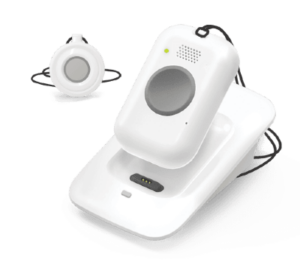

Info current as of post date. Offers and availability may vary by location and are subject to change.
MGHome Landline: Ideal for homes with unreliable cell service
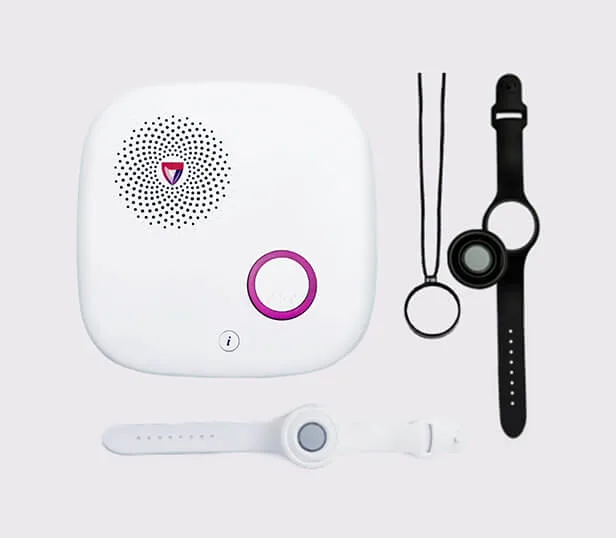
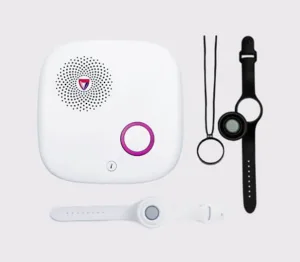
MGHome Landline with help button bracelet and necklace. Image credit: Medical Guardian
Unlike some competitors, Medical Guardian's landline option has the same 1,400-foot coverage area and features as its at-home cellular system. The obvious difference is the MGHome Landline connects to the monitoring center via an active landline instead of cellular service. This is a huge plus for users living in an area with unreliable cell service.
We think the MGHome Landline is a solid at-home option if you have a working landline and only need monitoring at home. You'll also save some money on the lower monthly monitoring fee compared to the MGHome Cellular.
MGHome Landline:
- Cost: $31.95/mo.
- Equipment fee: $149.95
- Available add-ons: Fall detection, extra necklace and bracelet help buttons, voice-activated and standard wall buttons, lockbox, protection plan, OnGuard alerts
MGHome Cellular: Ideal for exclusive at-home monitoring
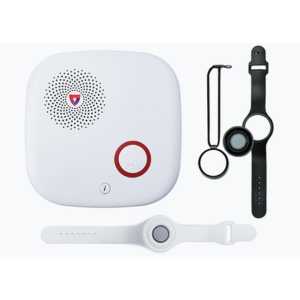
MGHome Cellular with help button bracelets and necklace. Image credit: Medical Guardian
The MGHome Cellular boasts all the same features and compatible accessories as the above landline system at a slightly higher monthly price. Wearable and wall buttons connect to the 24/7 monitoring center within 1,400 feet of the main plug-in base unit. We recommend it for those who only need monitoring in and around their home via cell service.
MGHome Cellular:
- Cost: $38.95/mo.
- Equipment fee: $149.95
- Available add-ons: Fall detection, extra necklace and bracelet help buttons, voice-activated and standard wall buttons, lockbox, protection plan, OnGuard alerts
MGMini: Ideal for users who want a low-tech, mobile device
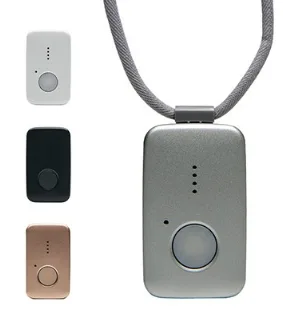
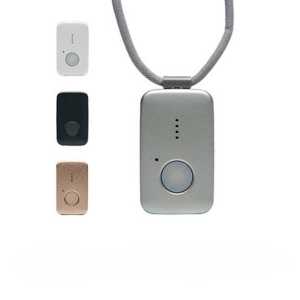
The MGMini is available in four colors. Image credit: Medical Guardian
The MGMini is a necklace that connects to the monitoring center anywhere with cell service. Whether you’re at home or running errands, all you have to do is press the button or trigger fall detection (an add-on feature) to speak directly with an agent.
We appreciate that Medical Guardian makes this necklace as customizable and discreet as possible. The MGMini is available in four colors (rose gold, silver, pearl, and black), weighs less than a small egg, and is barely two inches high. It also includes a belt clip to attach it to your purse or pocket when out and about.
The MGMini is a simple, one-button device. It tracks location, steps, and activity through an online portal or app that’s visible to both the user and caregivers. The system is water-resistant, so it can be worn in the shower and has a 3- to 5-day battery life.
MGMini:
- Cost: $43.95/mo.
- Equipment fee: $149.95
- Available add-ons: Fall detection, extra necklace and bracelet help buttons, voice-activated and standard wall buttons, lockbox, protection plan, OnGuard alerts
MGMini Lite: Ideal for active users wanting discretion
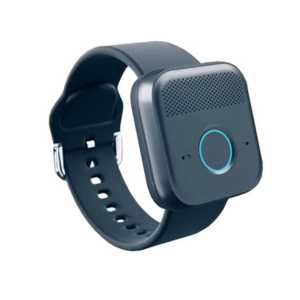
The MGMini bracelet is a simple mobile device. Image credit: Medical Guardian
The MGMini Lite resembles a fitness tracker or Apple Watch, but without the hassle of a touchscreen or extra apps and features. It has one button and a two-way speaker that connects to the monitoring via cell service. The small, sleek bracelet has optional fall detection, making it an excellent choice for active users who make exercise a regular part of their routine.
Like the MGMini, the Lite tracks location, steps, and activity via an online portal or app. Unlike the MGMini, the Lite isn’t compatible with extra wearable help buttons or wall buttons, making it a strictly wearable device.
Medical Guardian recommends charging the bracelet daily for optimal battery life. The MGMini Lite is water-resistant and can be worn when showering.
MGMini Lite:
- Cost: $46.95/mo.
- Equipment fee: $149.95
- Available add-ons: Fall detection, protection plan, lockbox, OnGuard alerts
MGMove: Ideal for integrating into daily routine
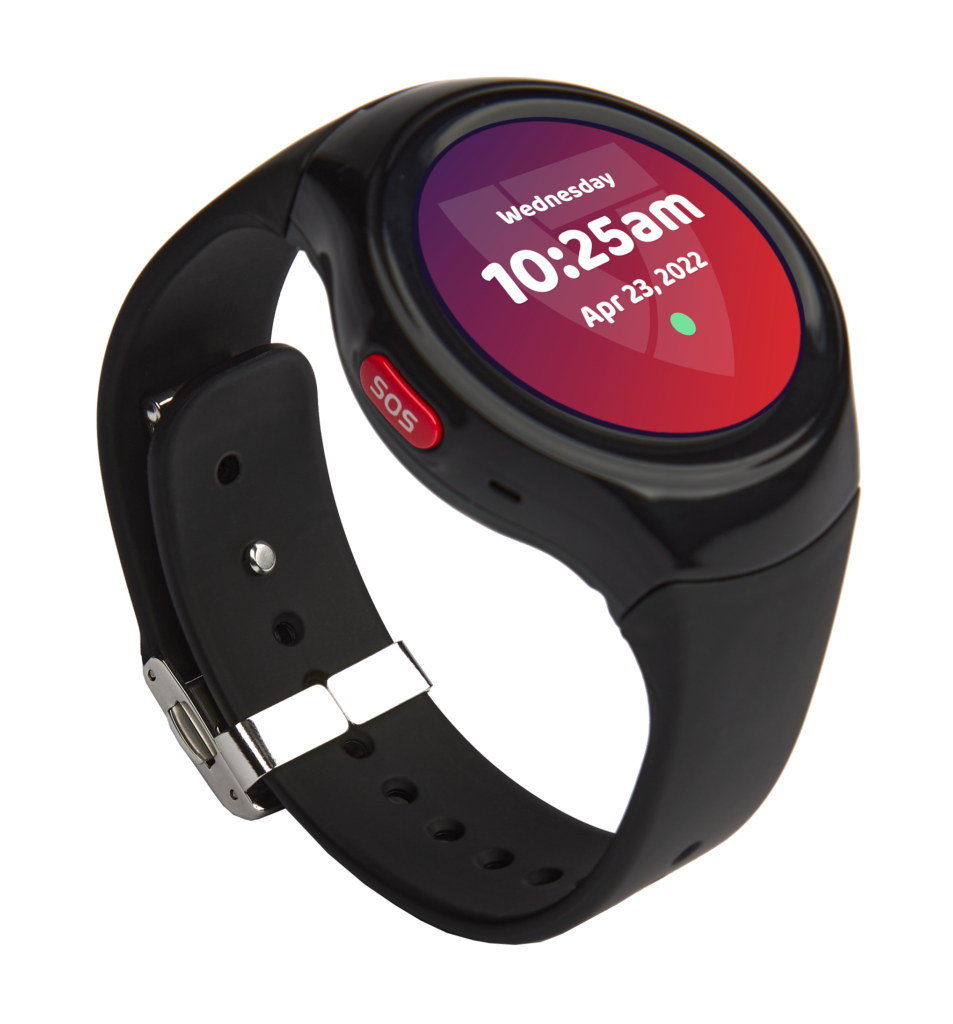
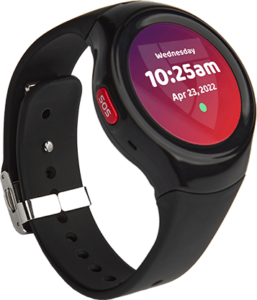
The MGMove has a touchscreen display. Image credit: Medical Guardian
The MGMove is a touchscreen smartwatch that connects to the monitoring center anywhere with cell service. It has a 24-hour battery life and is water-resistant.
Until recently, smartwatches were the premium, cutting-edge mobile medical alert systems. Now, many companies, including Medical Guardian, offer multiple on-the-go devices with various features and perks. Think of the MGMove as the most tech-savvy mobile option, with a touchscreen displaying daily steps, a weather app, and optional caregiver communication and reminders.
We recommend the MGMove for those who want to integrate their medical alert device into multiple parts of their daily routine, including physical activity and communication.
MGMove:
- Cost: $42.95/mo.
- Equipment fee: $199.95
- Available add-ons: Fall detection, lockbox, protection plan, OnGuard alerts, reminder and messaging apps
Does Medical Guardian have good customer service?
The Medical Guardian customer service options have changed slightly since I first covered medical alert systems. Paying customers still have access to an online portal where they can view things like account details and payments. (I also recommend using the FAQ and support pages.) But in the past, if I had a quick question, I could use the live chat feature to speak with a living, breathing customer service representative. The reps were always prompt and easy to understand.
Now, the online chat isn’t conversational. It only has three prompt options:
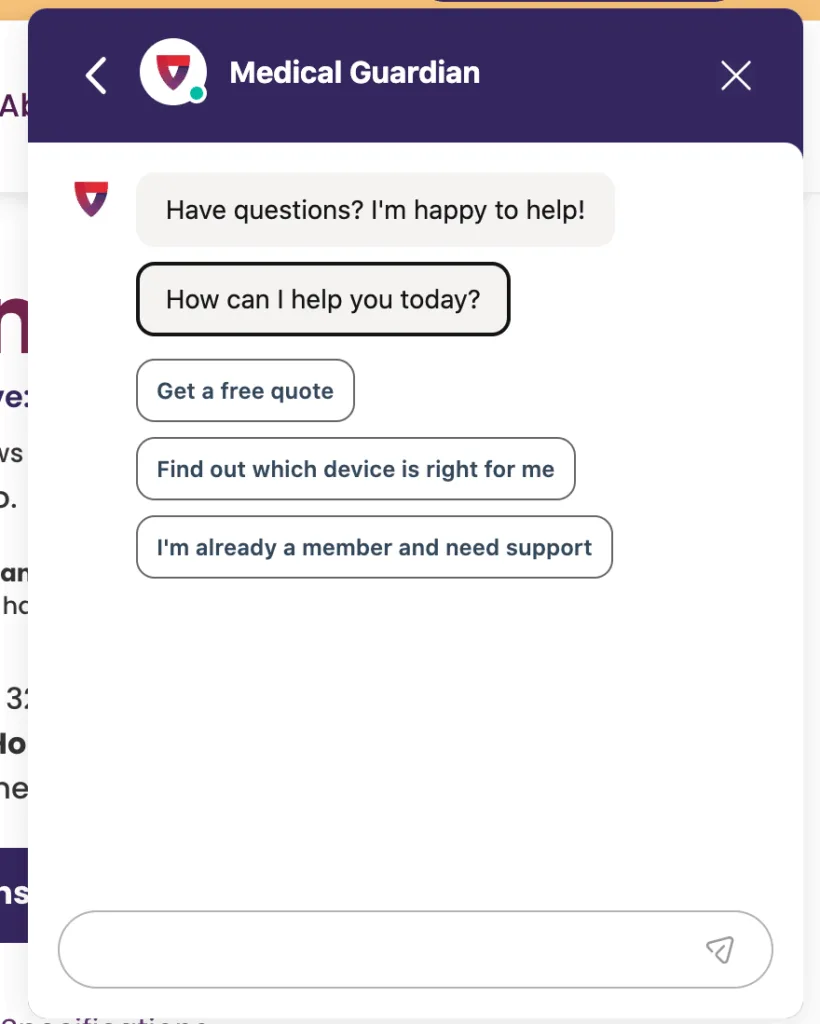
You can only choose from three prompts in Medical Guardian's customer service chat. Image credit: Emily Breaux, SafeWise
I tried “Find out which device is right for me” and was asked a few multiple choice questions about my lifestyle and preferences. Then, the chat recommended a Medical Guardian device based on my answers. I do think this feature can be helpful for customers not interested in browsing the entire website or immediately talking on the phone with a sales rep. And with the rise of AI search and assistants, shoppers will become even more comfortable with this automated, chat-like exchange. Ultimately, I would prefer speaking with a person, especially if I have more specific questions.
If you'd like to speak with a live customer service rep, we recommend calling customer service. It took me a few automated menus and transfers to get to an actual sales representative, but I was pleased with my experience once I reached them. They were helpful, friendly, and never pressured me into buying a device.
Most of the customer reviews I read also reported helpful and friendly representatives, reliable products, and even competitive price matching.
Some of our favorite customer-friendly policies include:
- 15-day free trial period
- No contract commitment
- Free pendant battery replacements
But I also saw feedback from upset customers who claimed issues like deceptive pricing — so be sure you fully understand whether you're paying a one-time fee or signing up for a monthly charge whenever you add an accessory or optional service to your bundle.
Other negative feedback included:
- Cancellation and refund issues
- Inconsistent or confusing policies
Free button battery replacements
One advantage of choosing Medical Guardian is that you don't have to worry about the in-home panic pendants running out of batteries. Medical Guardian's monitoring team keeps an eye on each pendant's battery life and sends you a brand-new pendant when it starts to run low—which usually takes about 5 years.
Medical Guardian FAQ
Medical Guardian systems cost about $32 to $47/mo., depending on the subscription, device, and features. At-home systems start at $32/mo. to $39/mo., while mobile systems start at $43/mo. to $47/mo. Fall detection is an extra $10/mo., and other services or accessories can increase the monthly price too.
Medical Guardian's MGHome Cellular and mobile medical alerts use the AT&T 4G cellular network.
A Medical Guardian rep confirmed that the MGMini also works on the Verizon network.
Medical Guardian no longer carries Family Guardian. This unique medical alert system was designed for caregivers who lived in a different home than their loved ones and doubled as a security system.
No, you can pay on a month-to-month basis and cancel at any time without penalty.
No, you do not need a cell phone to use Medical Guardian, they work independently. The at-home and mobile systems connect to a 24/7 monitoring center via a landline or cellular connection, depending on the device.
How we prepped for our Medical Guardian review
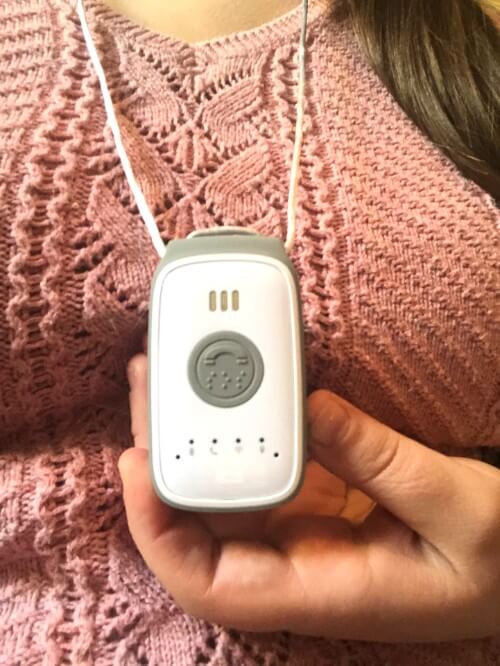
Image: Cathy Habas, SafeWise
For our Medical Guardian review, we compared prices, policies, and equipment from over 30 popular medical alert companies to see where Medical Guardian fell among them. We called sales reps and read customer reviews across the web to get the right answers.
Read our full methodology to learn more about how we rank this and other products we review on SafeWise.
Final word: Medical Guardian is our top pick for premium equipment and features
While Medical Guardian's price range doesn’t fit everyone’s needs, you get what you pay for with high-quality equipment. The signal range and battery life for most of its equipment leads the medical alert industry. We also think it's the best medical alert provider for system customization.


Recent Articles

The Best Fall Detection Devices
Find the best medical alert systems with fall detection. Compare equipment, price, accuracy, customer reviews,...

Jury Finds Meta and YouTube Negligent in Landmark Social Media Addiction Case
Meta and YouTube were found negligent in a landmark addiction case. Here’s why it matters...

How Safe Are the Fastest-Growing U.S. Cities?
Does a surge in population lead to a surge in crime? Find out in our...
Package Theft and Cybercrime Are Now the Most Common Crimes in America
State of Safety data shows Americans are more likely to experience package theft and cybercrime...


