

Here’s What People Said When We Asked How Safe Immigration Enforcement Makes Them Feel

Why you can trust SafeWise
products considered
250+
research hours in 25+ in-home tests
10k+
years of combined experience
176+
homes and people protected
10M+

For over 13 years, SafeWise experts have conducted independent research and testing to write unbiased, human reviews (not robots). Learn more.

Cathy Habas
Feb 26, 2026
Icon Time To Read5 min read
Icon CheckEdited ByRebecca Edwards
Icon CheckData Analysis ByDaniel Delgado
Cathy has been a SafeWise contributor since 2021, helping turn crime data into clear, useful safety insights.

In February 2026, SafeWise surveyed 1,250 Americans to learn how recent Immigration and Custom Enforcement (ICE) activities have affected their sense of safety and security. Many people reported feeling alarmed, unsafe, or unaffected. A minority reported feeling safer.

This underscores an important conversation taking place in our country: Is ICE doing more harm than good? What, if anything, needs to change? 

Below, we'll take a closer look at the connection between concern and safety and share one thing most people can agree on regardless of how they feel about ICE. We'll also share some candid responses from our survey, which may shed additional light on why people feel safe, unsafe, or neutral. 

Stay Safe and become a SafeWise Insider!

Sign up for our free weekly newsletter to get the best safety news, product info, and deals.

By signing up, you agree to our Terms and Conditions and Privacy Policy.

What, if anything, are you concerned about related to immigration enforcement activity?

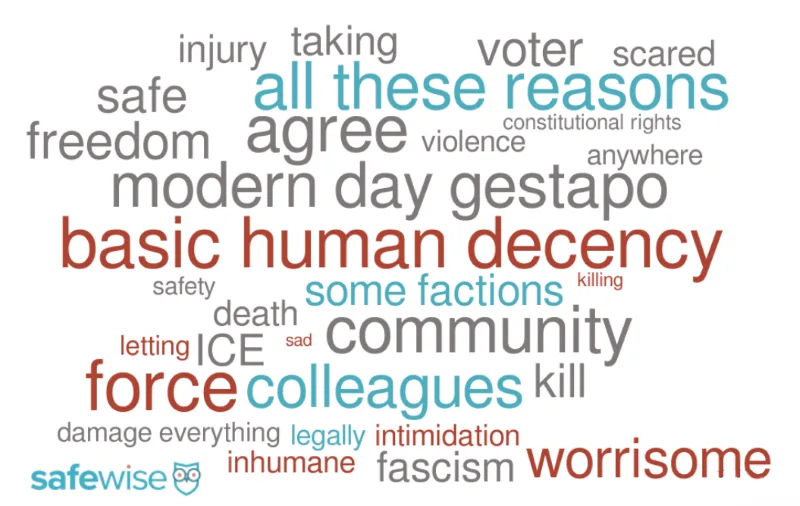
We asked a question to find out in specific detail what people are concerned about. A plurality of respondents cited impacts on their local communities:

  • Community tension or unrest (18%)
  • Risk of crime or violence (17%)
  • Impact on local economy or workforce (12%)

Around 8% to 14% expressed concern about the safety of individuals:

  • Risk of mistaken identity or wrongful detention (14%)
  • Personal safety (13%)
  • Safety of my family or household members (8%)

About 8% said they worried about the safety of their property (home, vehicle, or business). Six percent said they had no concerns. 

Word cloud displays frequently used terms from open-ended responses to the question, “What, if anything, are you concerned about related to immigration enforcement activity?” Terms reflect respondent language and are not weighted to represent overall sentiment distribution. As with all open-ended visualizations, term prominence reflects frequency, not context or endorsement. SafeWise Immigration Enforcement Pulse Survey fielded February 19, 2026.

In their own words

Voices from both perspectives

This question included the option to select "Other" and input a custom response. Just over 2% of respondents shared exactly how they felt. 

Most were critical of immigration enforcement, writing things like:

  • "ICE is pretty much the modern day gestapo"
  • "ICE is killing people"
  • "They kill people"
  • "Safety of my friends"
  • "Stripping away of constitutional rights"
  • "It's inhumane"
  • "Voter intimidation in midterms"
  • "Safety of colleagues"
  • "I'm scared for all these reasons"
Icon Quote  Dark
"I don’t believe I have anything to worry about because I’m born in the U.S and about as white as the snow, but I do have family members that could possibly be mistaken as a “target” for the ICE community. And they don’t deserve to live in a world of fear because of someone else’s “job”. Even hearing friends jokingly talk about ICE coming for them specifically because of their race is just sad and a little worrisome."
—SafeWise Immigration Pulse Survey respondent

While many respondents expressed fear or frustration, others described immigration enforcement as contributing to their sense of safety and order.

Icon Quote  Dark
"I feel safer because they are federal officers that have a duty of keeping our nation safer from criminals who are [here] illegally that have bad criminal records and have hurt and killed people."
—SafeWise Immigration Pulse Survey respondent

Other respondents expressed support for immigration enforcement, noting:

  • "Citizens aren't permitting ICE to do their job"
  • "People aren't letting ICE do their job"
  • "Cities aren't working with ICE which causes huge problems for everyone involved"
  • "ICE workers' safety and others in the line of fire"
Icon Quote  Dark
"It seems that guns have been used a lot and maybe we need to figure out another way to do this without them. I have only seen a few things about ICE on social media but I do agree with what they are doing. I want people to come here and be safe but do it legally."
—SafeWise Immigration Pulse Survey respondent

The totality of these responses reflects the divided nature of public opinion surrounding immigration enforcement and community safety.

What changes do you think would improve US immigration enforcement? — Concerned vs. unconcerned respondents

How has immigration enforcement activity affected how safe you feel in your community?

The final question of the SafeWise immigration pulse survey asked for a written response to this question: How has immigration enforcement affected how safe you feel in your community?

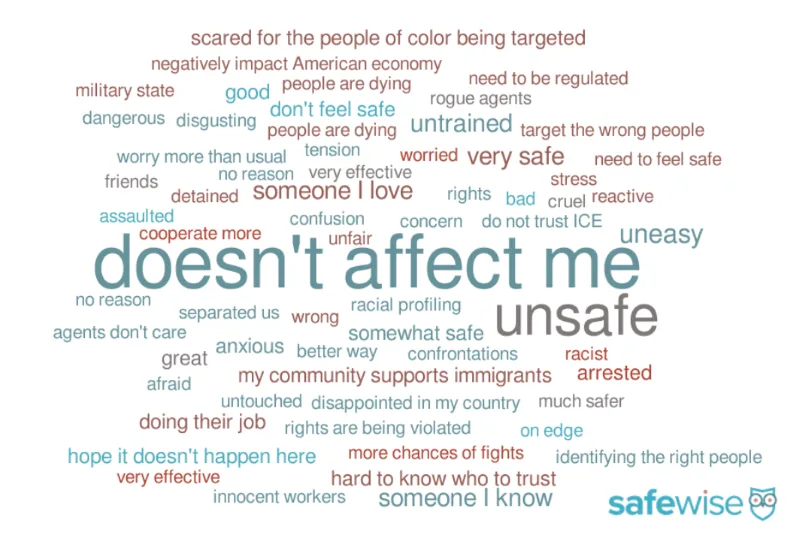
Many people said it hasn't affected their sense of safety.

Some added that it hadn't affected them yet. Others shared a belief that ICE wouldn't come to their area because no undocumented migrants live there. Multiple people said it doesn't affect them because they're white and unlikely to be racially profiled. 

A large number of respondents shared that they felt less safe in their community due to immigration enforcement activity. They reported increasing levels of anxiety, worry, uneasiness, distrust, and confusion. 

A minority of people wrote that they felt safer thanks to increased immigration enforcement activity. Some explained that they believe ICE agents are doing their job and doing it well. 

About 200 respondents (16%) told us they weren't concerned about anything related to immigration enforcement. When we asked what changes people would make to improve US immigration enforcement, 200 also said, "Don't change anything." 

We compared responses to see if the same 200 people — those with no concerns — also said they wouldn't change ICE's approach. Surprisingly, there was only about a 50% overlap.

Out of all the proposed changes on our survey, a body cam requirement was most supported by people who aren't critical of ICE. It's the most popular idea among all respondents too, with about 22% supporting the idea. But that's the only common ground between the two groups.

Compared to all respondents, people with no concerns are less likely to support mask bans for ICE agents, a change in ICE tactics to reduce collateral damage, an increase in congressional oversight of ICE, or an overhaul of the ICE agency. However, they're more likely to approve of an increase in ICE community engagement. 

Word cloud displays frequently used terms from open-ended responses to the question, "In your own words, how has immigration enforcement activity affected how safe you feel in your community?" Terms reflect respondent language and are not weighted to represent overall sentiment distribution. As with all open-ended visualizations, term prominence reflects frequency, not context or endorsement. SafeWise Immigration Enforcement Pulse Survey fielded February 19, 2026.

In their own words

Voices from both perspectives

We surveyed 1,250 people, so we'll only be able to share a small sample of responses. In some cases, questions included the option to select “Other” and input a custom response. Just over 2% of respondents shared exactly how they felt. Many people gave short answers like "Very unsafe" or "I feel safe." We'll focus on sharing some responses where people elaborated a little bit more.

Here are some answers from respondents who feel less safe:

  • "Not safe at all because I don't know what will happen when I walk out the door."
  • "I feel less safe because they are coming for people who film, which is our right. ICE invaded my city and terrorized people." 
  • "I don't feel safe with ICE around because they use excessive force." 
  • "I feel like anybody can put on a mask and claim to be law enforcement." 
  • "With immigration enforcement officers going after people who are documented citizens, it's a valid reason to feel affected safety-wise." 
  • "I don't feel safe around anyone who has been given absolute immunity from committing violent crimes, like murder."
  • "From what I've seen of ICE in my area, they need to learn how to calm the situation down instead of being very aggressive." 
  • "As a person of darker skin and Hispanic background, I am afraid I will be unfairly hurt or targeted." 
  • "It puts my relatives in danger, they don't want to go grocery shopping for fear of being arrested." 

While many respondents expressed concern or fear, a meaningful minority said immigration enforcement makes them feel safer.

Respondents who feel safer tend to say ICE is arresting people with criminal records:

  • "It has made me feel safer because some criminals have been taken off the streets."
  • "It's much safer because there's more police presence." 
  • "By removing illegal criminals it has made my community safer and more jobs are available for us residents." 
  • "I feel safe because they are federal officers that have a duty of keeping our nation safer from criminals who are [here] illegally that have bad criminal records and have hurt and killed people."
  • "I feel safer with enforcement practices because there's too much crime without it."
  • "I feel safer. A lot of ICE are just doing their job while some are corrupt, that's nothing new. For the ones doing their job right they're making our nation safer."
  • "Crime is lower recently, some of that is probably due to ICE removing some bad people. I feel a bit safer."
Icon Bell  Dark
Data context: ICE arrest records

Some respondents who feel safer cited the removal of individuals with criminal records. According to an independent review of Department of Homeland Security statistics, roughly 60% of individuals arrested by ICE have been accused or convicted of a crime, and most of those crimes were non-violent. More than 80% did not have a documented history of violent crimes.

About 11% of those arrested have been accused or convicted of physical assault. Less than 6% have a connection to dangerous drugs, 1.4% to sexual assault, 0.7% to robbery, 0.5% to homicides, and 0.3% to kidnapping.

Next up: Read the full report

Get more insights by reading the full report:

Make sure you understand your rights and how to stay safe if ICE comes to your area. Even if you're a legal citizen, it never hurts to brush up on protocol. 

Cathy Habas
Written by
With over 12 years of experience as a content writer, Cathy has a knack for untangling complex information. Her natural curiosity and ability to empathize help Cathy offer insightful, friendly advice. She believes in empowering readers who may not feel confident about a purchase, project, or topic. Cathy earned her Bachelor of Arts degree in English from Indiana University Southeast and began her professional writing career immediately after graduation. She is a certified Safe Sleep Ambassador and has contributed to sites like Safety.com, Reviews.com, Hunker, and Thumbtack. Cathy’s pride and joy is her Appaloosa “Chacos.” She also likes to crochet while watching stand-up comedy specials on Netflix.

Recent Articles

ICE Enforcement in a town.
How to Prepare for ICE Enforcement: Know Your Rights and Stay Safe
Learn how to prepare for ICE enforcement, understand your rights, protect your family, and know...
""
SafeWise 2026 Safety Guide
It's rough out there. SafeWise rounded up safety experts for the best tips on how...
Tracki GPS Tracker Review
We review the Tracki GPS Tracker—a compact, versatile device ideal for tracking children, vehicles, and...
BoT Talk Review
The BoT Talk offers voice messaging, GPS tracking, and geofencing without the temptation of a...