

Electronic door locks (also called smart locks) are a way to replace keys or to add additional home automation features, like remote locking or unlocking. Although most commonly found on cars, electronic door locks are now offered by many cutting-edge security providers for homes and businesses.
What Are Electric (Smart) Door Locks and How Do They Work?
Why you can trust SafeWise
products considered
250+
research hours in 25+ in-home tests
10k+
years of combined experience
176+
homes and people protected
10M+
For over 13 years, SafeWise experts have conducted independent research and testing to write unbiased, human reviews (not robots). Learn more.

 3 min read
 Reviewed ByRebecca Edwards
Bio: With 25+ years in tech journalism, Alina blends safety expertise with her passion for simplifying technology. Alina has tested hundreds of safety and security devices, is trained as a first responder, and has worked as a volunteer firefighter.

Last Updated: 10 hours ago
Updated for accuracy.
Video: What are electronic door locks?
Subscribe to our YouTube channel for more videos like this one! Learn how to protect your home, your loved ones, yourself and your belongings.
Types of door locks
In any type of door lock, a latch or bolt is made to cross the opening between the side of the door and the doorframe, preventing access. This can be a “spring bolt,” which is held in place by springs and allows the door to close (but not reopen) when locked, or the more secure “dead bolt,” which stays in place until manually unlocked.
In both cases, locking and unlocking is achieved by rotating the visible element (a knob or a key in a lock cylinder) to move the bolt or latch.
Traditional key locks
Traditional key locks use some variation of the “pin and tumbler” method, in which the lock cylinder is held in place with a line of small metal pins, each of which consists of an upper and lower half. When a key is inserted and turned, the uneven “serrated” edge ensures that each pin is moved a certain distance. The cylinder may be turned only when each pin is moved just enough to create a straight separation between the upper and lower halves of all pins.
Electronic key locks
Electronic door locks also involve parts called “actuators,” which connect the bolt or the cylinder to a small motor completely buried within the door or frame itself.
The motor is controlled by an electrical impulse, which may be triggered in a number of ways:
- Electronic card reader
- Keypad
- App
- Fingerprint reader
- Key fob
- Face scanner
No matter what triggers it, the electronic door lock is configured to start the motor-driven actuator only once it has received the correct electronic input.
Traditional vs. electronic door locks
Each method of locking has pros and cons.
Convenience
Physical keys, such as metal keys, key cards or handheld remotes, can be lost or damaged, while numerical key codes can be forgotten (or learned and memorized by the wrong person).
Key codes can be quickly and easily changed by the user when necessary, while changing physical locks and keys is much more involved, requiring specialized hardware and expertise.
Reliability
Power failures are problematic for purely electronic door locks, causing them to remain locked or unlocked until the electricity has been restored or the battery replaced.
On most electronic door locks, you’ll find some combination of physical and electronic locking control on the same door. For example, you may have a physical key for setup and emergency backup, but use the remote or keypad to lock and unlock the door on a day-to-day basis. This provides an extra layer of convenience and safety for the user, but may also provide additional functionality as well.
Compatibility
There are physical locks to fit any kind of door, but electronic door lock styles are more limited.
That said, electronic door locks available for traditional swing doors, and electronic sliding door locks are becoming more common now too.
Smart locks and home security
With a sophisticated automated system, electronic door locks can be controlled and monitored remotely.
In the case of cars, this means that you can lock and unlock the doors (or pop the trunk, or start the engine) while still some distance away from the vehicle.
With homes or businesses, this can mean even more. Automated systems can be programmed to lock the doors for you at set times during the day, just in case you forgot. Remote monitoring apps can allow you to use your smartphone to see if there are any unlocked doors, and lock them from anywhere in the world. In the worst case, you can unlock your door remotely for quick, non-destructive access to fire and police personnel if an emergency occurs when you’re away from home.
Which home security companies sell smart locks?
Not all home security packages include electronic door locks with remote monitoring. Here's what to expect from the top home security brands:
- Frontpoint sells a Yale smart lock.
- SimpliSafe sells a proprietary electronic door lock called the SimpliSafe Smart Lock.
- Wyze also sells a proprietary device called the Wyze Lock.
- Yale, Schlage, and Level Bolt sell electronic door locks.
- Abode doesn't sell any electronic locks directly, but its system works with a few models from Kwikset, Yale, Schlage, and August.
- ADT Self Setup works with any Z-Wave smart lock.
- Cove sells its own smart lock.
Learn more about the best smart home security systems.
Compare the best home security systems
Brand | Self-monitoring option | Monthly cost
 | Starter equipment price | Break-in deterrent(s)
| Smart home compatibility
| Learn more |
 No No | $28.99/mo.* | $0.00 | Smart AI detection, 2-way talk, Yard sign/window decal | Google, Z-Wave | View packages | |
 Yes Yes | $22.80/mo. | $250.96 | Active Guard, AI detection, Live agent intervention, Siren | Amazon, | View packages | |
| No | $24.99/mo. | $199.00 | Smart Deter lurker detection, Lights, Sounds | Amazon, Google, Z-Wave | View packages | |
| No | $19.99/mo. | Custom | Motion sensors/cameras, Glass break sensor, Siren | Amazon, Google | View packages | |
| Yes | $26.99/mo. | $65.00 | Acoustic/vibration sensors, AI-powered alerts, Smart security integration | Amazon, Google, Apple, Z-Wave, Zigbee | View packages |


Info current as of post date. Offers and availability may vary by location and are subject to change. *ADT $28.99 for landline system only. Full ADT disclaimer


Recent Articles

Dangerous Apps for Kids: What Parents Need to Know in 2026
Dangerous apps for kids include ones you’ve heard of (TikTok, Instagram) and some new arrivals....
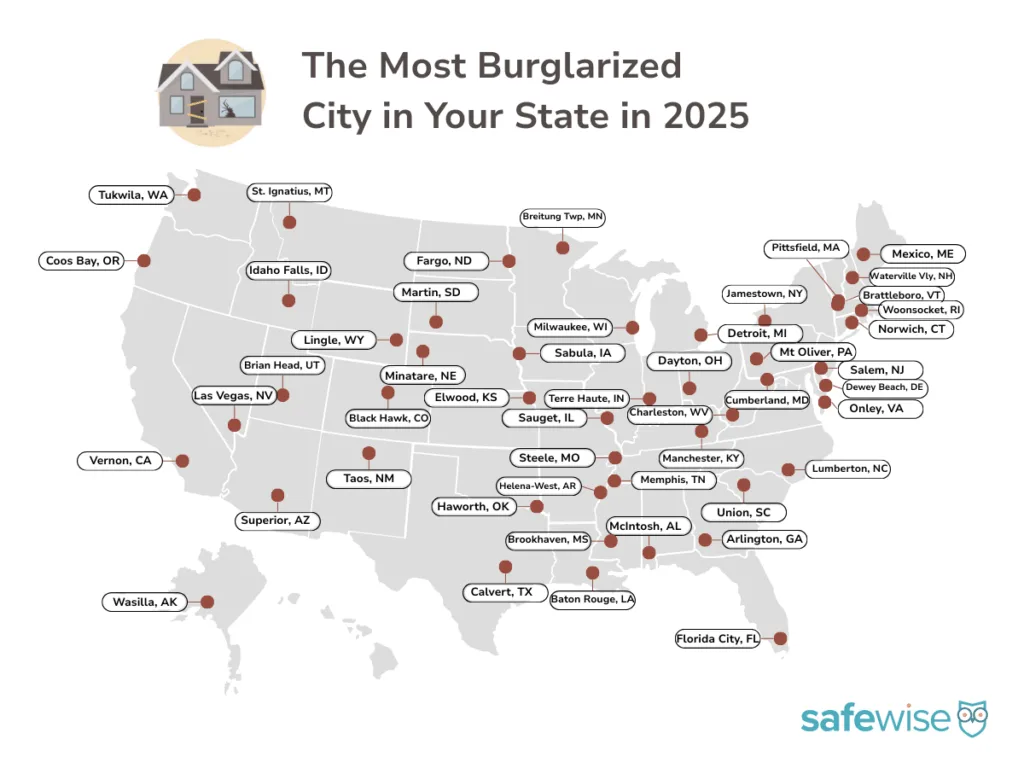
The Most Burglarized City in Every State
We found the most-burglarized city in every state — it looks like burglars are equal...
Ring Security vs. Frontpoint
Frontpoint is our pick in this DIY security system matchup. Its starter package is more...
Best Smoke Detectors of 2026
We reviewed the top fire and smoke alarms for your home in 2026. Protect your...


