

How America’s Safety Concerns Shifted in Six Months

Why you can trust SafeWise
products considered
250+
research hours in 25+ in-home tests
10k+
years of combined experience
176+
homes and people protected
10M+

For over 13 years, SafeWise experts have conducted independent research and testing to write unbiased, human reviews (not robots). Learn more.

Rebecca Edwards
Mar 05, 2026
Icon Time To Read4 min read
Icon CheckData Analysis ByDaniel Delgado

Rebecca helps you stay safe without the stress | Managing Editor | 12+ yrs in home + personal security | 30+ yrs in journalism | Expertise featured by NYT, PBS, Today Show, and more.

When we conducted the August 2025 State of Safety survey, the national mood was uneasy. To capture what Americans were most worried about, we asked how concerned they were about different issues, including the economy, political unrest, immigration, and gun control. Whether shaped by outside influence (headlines) or internal conflict, over half of the people surveyed expressed concern about every issue except religion and gender.

Six months later, in February 2026, the landscape looks similar at first glance — but the undercurrents have shifted in meaningful ways. To see how anxiety and concerns changed in the past six months, we conducted a pulse survey.

Unsurprisingly, the economy still dominates — as noted in coverage following the State of the Union address — and worry about political unrest remains high. But beneath those constants, concern is redistributing.

Cultural and identity-linked issues are rising sharply, while some traditionally headline-driven fears, like gun control, are cooling.

What we're seeing today isn’t necessarily a calmer, less concerned America; it’s a recalibrating one.
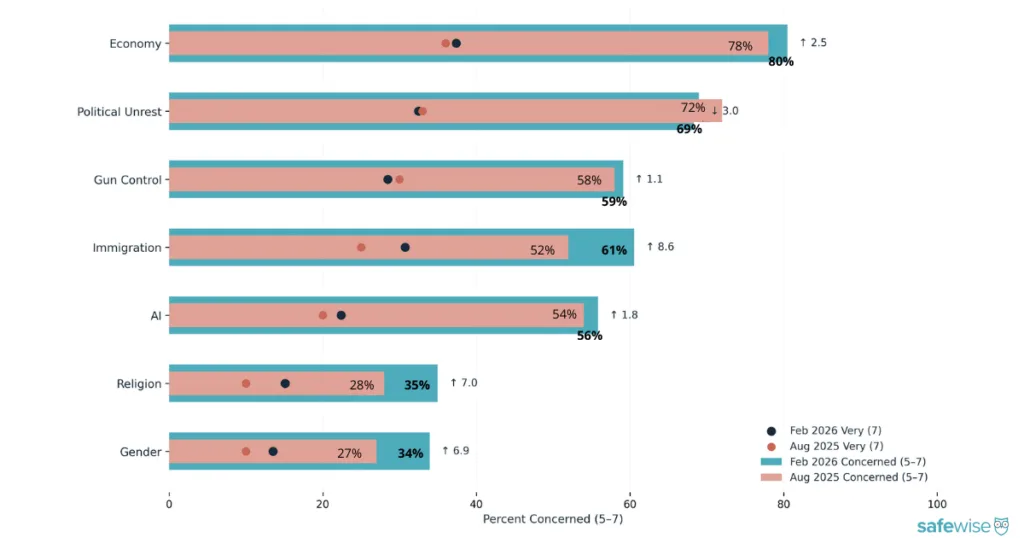
How Americans' safety & security concerns changed between August 2025 vs February 2026

We asked Americans how concerned they were about different social issues, to measure changes in sentiment over six months. Concerns increased for every issue except political unrest, where concern decreased slightly. Image: SafeWise

The economy: Still King — and still heavy

If there is one throughline from August to February, it’s economic anxiety.

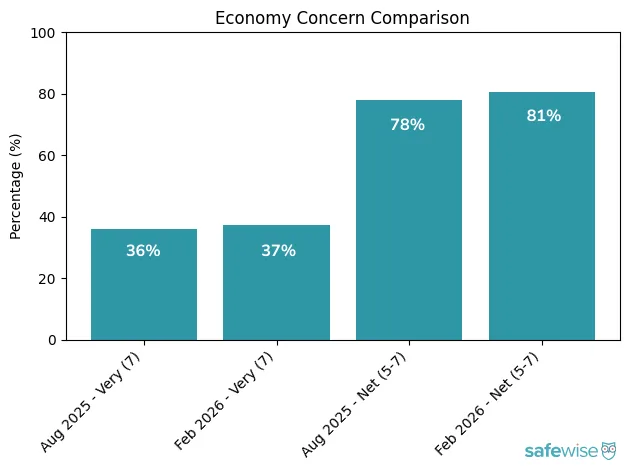
In August 2025, 36% of Americans said they were very concerned about the economy, and 78% were concerned overall (rating it 5, 6, or 7 on a 7-point scale). By February 2026, those numbers ticked up to 37.4% very concerned and 80.5% concerned overall.

While the increase is modest — roughly +2.5 points in total concern — it's still worth noting. Despite shifts in media cycles and political debates, the economy remains the central shared concern of most Americans.

Despite reassurances from official sources, economic anxiety for the average American hasn’t receded into the background — it's hardened into baseline worry.

Concern about the economy rose slightly between August 2025 and January 2026. Image: SafeWise

Political unrest: A slight cooling

In contrast to the economy, concern about political unrest and instability dipped slightly.

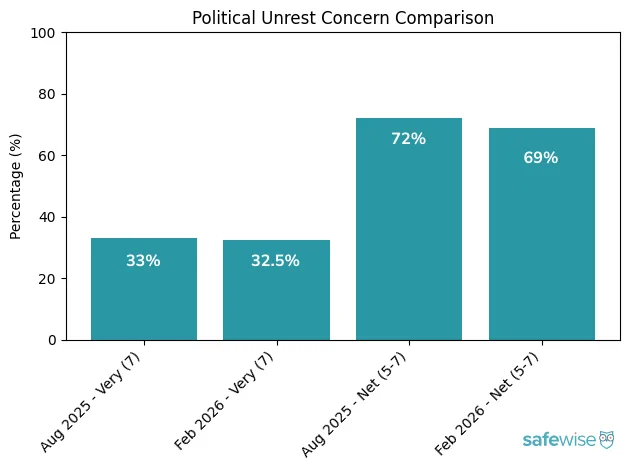
In August, 33% were very concerned, and 72% were concerned overall. By February, that fell to 32.5% very concerned and 69% concerned overall — about a 3-point decline in total concern.

This isn’t a dramatic shift, but it is notable. Political instability was one of the defining anxieties of mid-2025. The February data suggest either stabilization, normalization, or perhaps fatigue. When instability becomes a steady backdrop, it can lose its ability to provoke acute spikes in concern.

We asked Americans how concerned they were about political unrest, and concern slightly went down between August 2025 and February 2026. Image: SafeWise

Gun control: Steady but stable

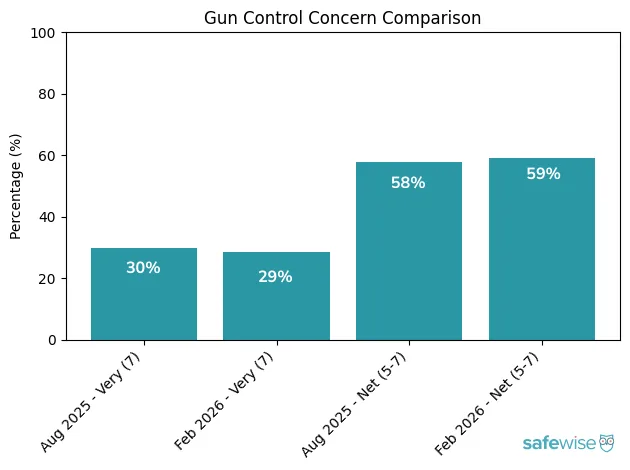
Concern about gun control presents a more stable picture. The percentage of respondents who said they were very concerned dipped slightly from 30% in August to 28.5% in February. However, total concern rose marginally from 58% to 59%.

That combination suggests that concern about gun control may be softening somewhat, but it's still a strong concern overall. It's likely that intense concern about this issue peaks during national or local events.

Concern about gun control was relatively stable between August 2025 and February 2026. Image: SafeWise

Immigration: The sharpest rise

The most significant movement in the data belongs to immigration — the issue that drove us to conduct the pulse survey.

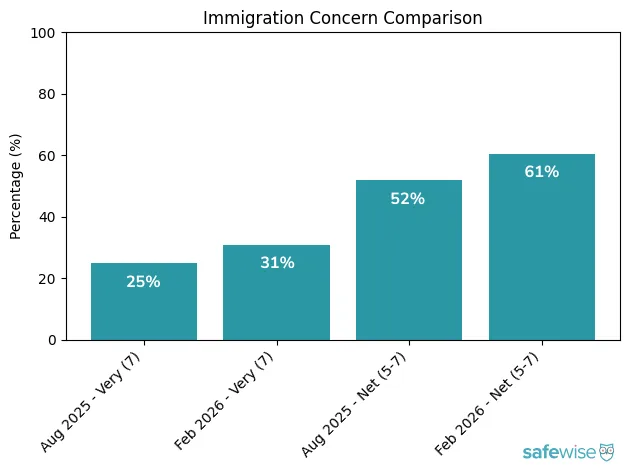
In August 2025, 25% of Americans were very concerned about immigration, and 52% were concerned overall. By February 2026, those numbers jumped to 30.7% very concerned and 60.6% concerned overall.

That’s an 8.6-point increase in total concern — the largest shift among all measured issues.

Unlike the economy, which remains consistently high, immigration shows acceleration. Increased immigration enforcement activities and ongoing coverage of clashes in communities like Minneapolis, Portland, OR, and Los Angeles have likely elevated its urgency in the public mind.

Concern about immigration, in general, rose sharply between August 2025 and February 2026. Image: SafeWise

Bell
Special Report: Immigration concerns on the rise

AI: From emerging issue to structural concern

We first asked how concerned people were about AI (artificial intelligence) in 2025. In just six months, this area of concern shows moderate growth.

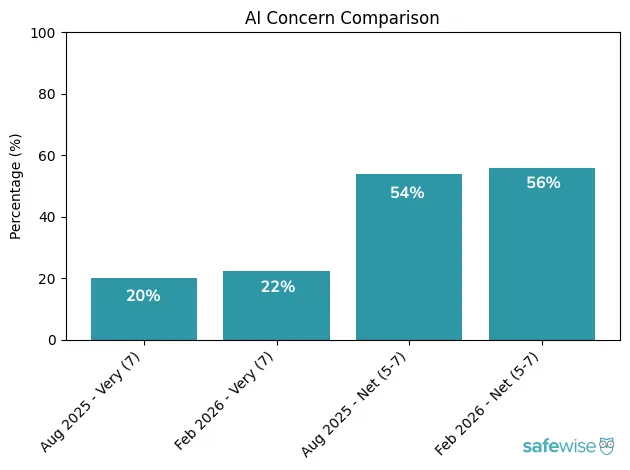
In August, 20% were very concerned about AI, and 54% were concerned overall. By February, that rose to 22.4% very concerned and 55.8% concerned overall.

These aren't explosive increases, but they indicate that concern about artificial intelligence may become a growing issue. Unlike immigration or gun control, AI concerns are less event-driven and more structural. As awareness of automation, misinformation, and technological disruption deepens, concern is likely to build gradually rather than reactively.

Americans showed slightly greater concern about AI in February 2026 than in August 2025. Image: SafeWise

Religion and gender: The quiet surge

Some of the most surprising movements are tied to issues of culture and identity.

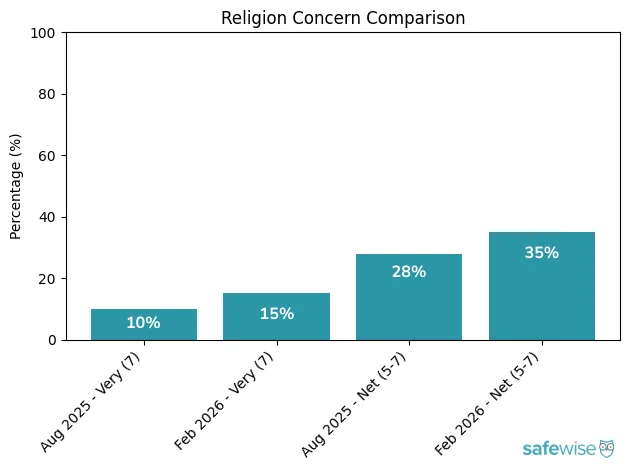
Concern about religion rose from 28% overall in August to nearly 35% in February — a 7-point jump. Those very concerned increased from 10% to 15%.

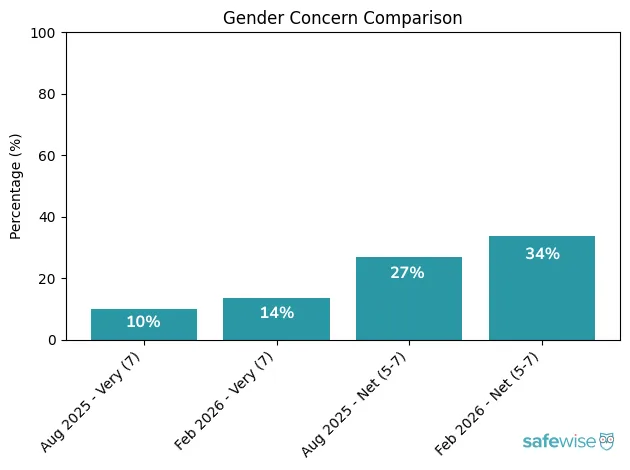
Similarly, concern around gender rose from 27% overall to 34%, with very concerned responses climbing from 10% to 13.5%.

These aren't the highest-ranking issues in absolute terms, but their rapid growth is meaningful. In six months, both religion and gender saw larger increases than the economy or AI.

Scroll to see both charts. Although religion and gender inspire less concern than the other issues we asked about, both saw a rise in worry between August 2025 and February 2026. Image: SafeWise

How concern about key issues changed in six months

Side-by-side comparison (August 2025 → February 2026)
Issue
Aug 2025 (Very) Icon Tooltip  Dark
Feb 2026 (Very) Icon Tooltip  Dark
Change Icon Tooltip  Dark
Aug 2025 (Net) Icon Tooltip  Dark
Feb 2026 (Net) Icon Tooltip  Dark
Change Icon Tooltip  Dark
Economy36%37.36%+1.3678%80.48%+2.48
Political unrest33%32.48%-0.5272%68.96%-3.04
Gun control30%28.48%-1.5258%59.12%+1.12
Immigration25%30.72%+5.7252%60.56%+8.56
AI20%22.40%+2.4054%55.84%+1.84
Religion10%15.12%+5.1228%34.96%+6.96
Gender10%13.52%+3.5227%33.92%+6.92

What this tells us

Taken together, the data suggest three broader trends:

  • Economic anxiety remains foundational. It shows up as an anchor issue, thus far resistant to fluctuation.
  • Immigration has surged most dramatically. It represents the most marked upward movement in concern over the past six months.
  • Cultural issues are gaining ground. Religion and gender show meaningful growth, indicating heightened sensitivity to identity-based debates.

Meanwhile, political unrest — once a dominant flashpoint — shows modest cooling.

This isn’t a story of fear escalating across the board. It’s a story of redistribution. Americans are not simply more or less anxious — they are anxious about slightly different things.

Rebecca Edwards
Written by
Rebecca is the Managing Editor and lead safety expert at SafeWise.com, where she's been researching, testing, and writing about home and personal security for over 12 years. Her safety smarts come from both real life and professional experience—as a single parent trying out safety and security gadgets to protect her family and a former college director responsible for safety plans and strategies to keep buildings, grounds, and hundreds of students and faculty safe every day. With 30 years of experience as a journalist and blogger, she's become a go-to source for trustworthy, practical advice on everything from the best home security systems and smart gadgets to keeping kids safe online, preventing package theft, and understanding crime trends nationwide. PBS NewsHour, The Today Show, NPR, Vice, TechCrunch, The Washington Post, HGTV, Marketplace, On the House, and more have featured Rebecca's expert insights and recommendations. Whether it's protecting your home, your loved ones, or your peace of mind, Rebecca makes safety simple, doable, and real.

Recent Articles

Child using smartwatch with location indicated on a map.
What Is Geofencing, and Does It Work?
Learn how geofencing on kids smartwatches really works, including GPS accuracy limits, boundary sizes, notification...
mSpy Review — Is This Parental Control Software Right for You?
mSpy is a parental control app with powerful features, but is it the best solution...
kids blowing bubbles
Verizon Gizmo Watch Review
Our child safety expert compares the Verizon Gizmo Watch 3 and Gizmo Watch 3 Adventure....
ICE Enforcement in a town.
How to Prepare for ICE Enforcement: Know Your Rights and Stay Safe
Learn how to prepare for ICE enforcement, understand your rights, protect your family, and know...