

 3 min read
 Edited By
See crime rates for the safest cities.
Washington’s Safest Cities of 2026
For over 13 years, SafeWise experts have conducted independent research and testing to write unbiased, human reviews (not robots). Learn more.

Cathy has been a SafeWise contributor since 2021, helping turn crime data into clear, useful safety insights.

Here are the 10 Safest Cities in Washington for 2026
According to our most recent State of Safety report, people in Washington worry more about crime and safety on a daily basis than most of America, but they're less likely to experience crimes first-hand.
Meanwhile, official FBI data confirms that crime rates are down across the state. This trend is also evident in Washington's 10 safest cities, many of which have seen impressive decreases in crime over the last couple of years.
In this report


Download the full list of cities in your state
Enter your email to get the full list with crime stats.
By signing up, you agree to our Terms and Conditions and Privacy Policy.
NOTE: If your city is missing from our full report, it means that it was below the population threshold or didn’t submit a complete crime report to the FBI in 2023.
Washington crime rates and safety concerns
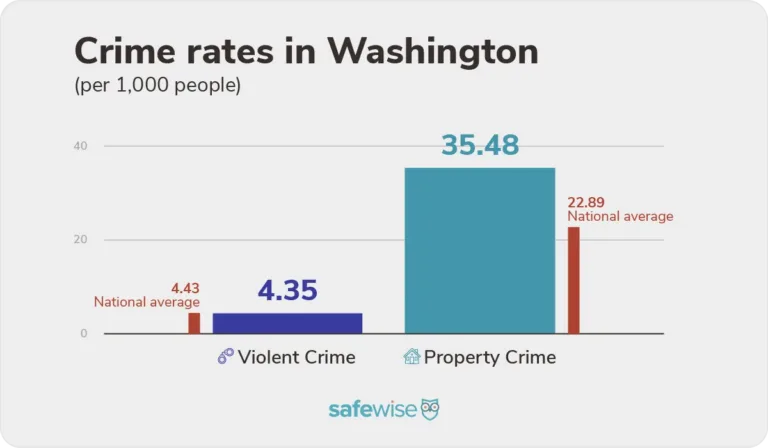
Bar chart comparing Washington violent and property crime rates to national averages. Washington's violent crime rate is below average and its property crime rate is above average. Image: SafeWise
The violent crime rate in Washington is 4.35 incidents per 1,000 people, which is lower than the national average of 4.43. We weren't able to report a statewide violent crime rate last year due to insufficient data, but in our 2024 report, Washington reported a higher violent crime rate of 4.7.
Property crime in The Evergreen State also decreased in recent years, falling slightly from 35.6 incidents per 1,000 people in 2024 to 35.48 incidents in this year's report. Still, that's higher than the national property crime rate of 22.89 and is the third highest property crime rate in the country.
Washingtonians who took our State of Safety survey report a higher confidence level than the year before. About 50% say they feel safe in the state, up from 42%.
Property crime in Washington: Fear vs. reality
In our 2025 report, Washington residents were the most likely to experience package theft nationwide, with nearly half of our participants indicating they'd personally experienced this issue in the 8 months prior to our survey. In this year's report, Washingtonians saw a dramatic decline in their property crime and package theft experiences, and they're now less likely to experience them compared to the average American.
- 19% said they personally experienced a property crime in the 12 months prior to our survey, down from 35% from the last two years (US 21%).
- Concern about property crime fell year over year from 60% to 49% (US 46%).
- 27% of Washington residents said they experienced a package theft in the 12 months prior to our survey, down from 48% the year before (US 31%).
- Concern about package theft fell from 58% to 46% year over year (US 44%).
- Washington residents prefer to protect their property with security cameras (48%), security systems (31%), and guard dogs (27%).
"I'd say property theft crimes are up in a big way."
—Washington resident*
—Washington resident*
What security measures are used most in Washington?
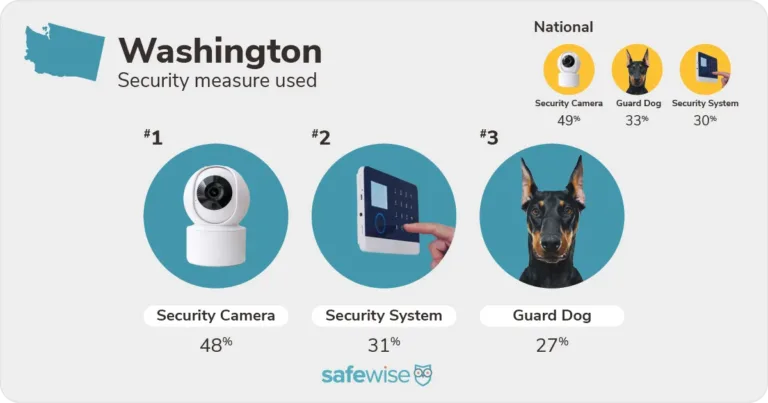
Top security measures used in Washington (security cameras, security systems, and guard dogs) compared to national trends. Image: SafeWise
What crimes are Washington residents most concerned about?
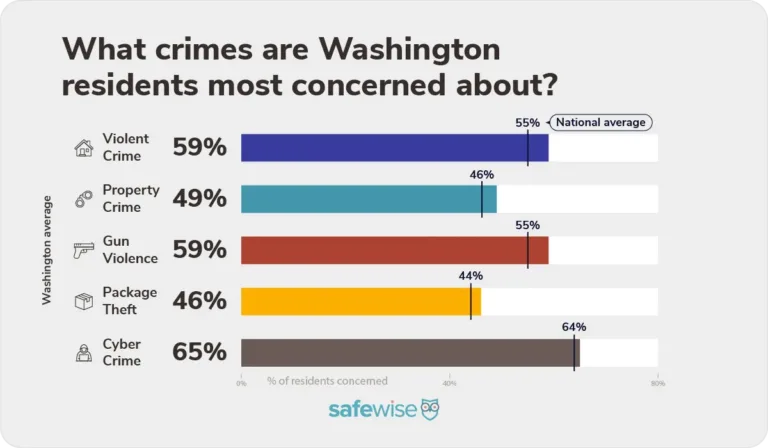
Bar chart showing the percentage of Washington residents concerned about violent crime, property crime, gun violence, package theft, and cyber crime. Image: SafeWise
Violent crime in Washington: Fear vs. reality
Washingtonians saw a decline in violent crime experiences year over year, and they're now less likely to experience violent crime than the average American. Gun violence experiences also decreased. Washingtonians worry about both issues equally.
- 9% said they personally experienced a violent crime in the 12 months prior to our survey, down from 14% the year before (US 12%).
- Concern about violent crime fell slightly from 60% to 59% year over year (US 55%).
- 32% of Washingtonians use some form of personal protection.
- Washington residents prefer to protect themselves with pepper spray (44%), firearms (38%), and pocket knives (34%).
- Washingtonians are more likely to use stun devices, keychain weapons, personal safety apps, and alarms or whistles than the average American.
"I can no longer shop after dark because it is not safe."
—Washington resident*
—Washington resident*
Attitudes about gun violence in Washington
- 8% said they experienced gun violence first-hand in the 12 months prior to our survey, down from 11% the year before (US 9%).
- Concern about gun violence fell slightly from 60% to 59% year over year (US 55%).
- Washington experienced 7 mass shooting events in 2025, up from 6 in 2024.
"My biggest concern would be gun violence and the fear of being unsafe. Also the safety of my children."
—Washington resident*
—Washington resident*
*Quotes collected from our State of Safety survey.
A closer look at the safest cities in Washington
For the purposes of this report, the terms “dangerous” and “safest” refer explicitly to crime rates as calculated from FBI crime data—no other characterization of any community is implied or intended.
- 82 cities met the criteria for ranking this year.
- Sedro-Woolley is this year's safest city in Washington.
- Property crime has decreased for the last three years in a row in Sedro-Woolley, resulting in a total decrease of 72%. The city's violent crime rate has decreased by 85% over the last two years.
- Sedro-Woolley is the only city to report no aggravated assaults.
- Snoqualmie's property crime rate fell by 56% over the last two years and is back to about the same level as in the 2022 reporting year (11.8).
- Over the last two years, Sammamish's property crime rate declined by 41%, Camas and Battle Ground's declined by 37%, and Lake Stevens's declined by 35%.
- 60% of Washington's safest cities saw year-over-year decreases in violent crime.
- 1 murder was reported in Washington's safest cities. It happened in Kenmore.
- Sedro-Woolley reported zero aggravated assaults.
- All of Washington's safest cities reported 1 or more rapes.
The 10 safest cities in Washington
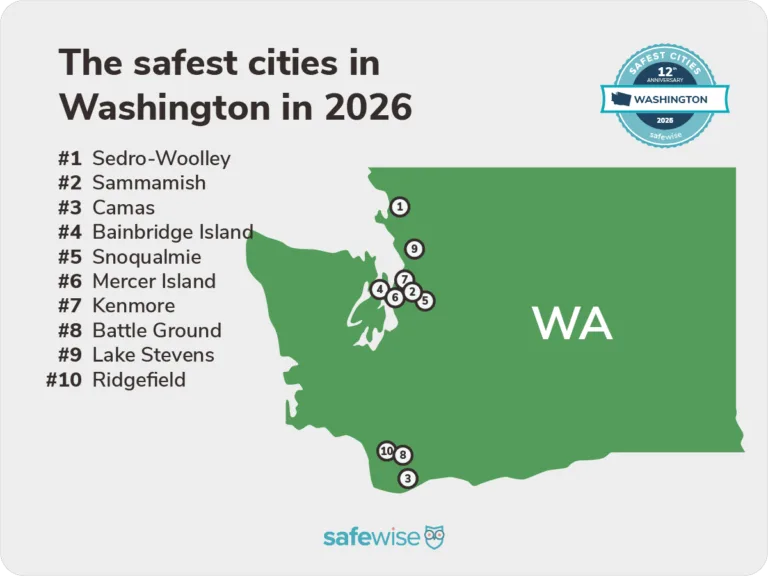
Map of the safest cities in Washington for 2026, listing top 10 ranked cities based on SafeWise crime data. Image: SafeWise

#1
Sedro-Woolley
(
 )
)
+1
-
 Population13,103
 -
 VC Rate 2026, 2025, 20240.2, 0.3, 1.3
 -
 PC Rate 2026, 2025, 20246.9, 10.6, 19.3
 -
 VC=Violent crime, PC=Property crime

#2
Sammamish
(
 )
)
-1
-
Population64,358
-
VC Rate 2026, 2025, 20240.3, 0.3, 0.6
-
PC Rate 2026, 2025, 20245.5, 6.2, 9.3
-
VC=Violent crime, PC=Property crime

#3
Camas
(
-0-
)-
Population27,525
-
VC Rate 2026, 2025, 20240.5, 0.3, 0.3
-
PC Rate 2026, 2025, 20247.9, 11.5, 12.5
-
VC=Violent crime, PC=Property crime
#4
Bainbridge Island
(
)
+1
-
Population24,063
-
VC Rate 2026, 2025, 20240.4, 0.5, 0.9
-
PC Rate 2026, 2025, 202410.1, 10.0, 15.8
-
VC=Violent crime, PC=Property crime
#5
Snoqualmie
(
)
-1
-
Population13,265
-
VC Rate 2026, 2025, 20240.5, 0.2, 0.1
-
PC Rate 2026, 2025, 202411.2, 13.8, 25.6
-
VC=Violent crime, PC=Property crime
#6
Mercer Island
(
)
+1
-
Population24,416
-
VC Rate 2026, 2025, 20240.4, 0.7, 0.9
-
PC Rate 2026, 2025, 202414.1, 12.2, 18.4
-
VC=Violent crime, PC=Property crime

#7
Kenmore
(
)
+2
-
Population23,227
-
VC Rate 2026, 2025, 20240.7, 0.8, 0.6
-
PC Rate 2026, 2025, 202410.1, 11.5, 13.2
-
VC=Violent crime, PC=Property crime
#8
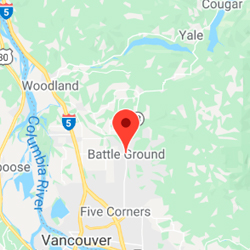
Battle Ground
(
)
+6
-
Population22,780
-
VC Rate 2026, 2025, 20240.8, 1.1, 1.5
-
PC Rate 2026, 2025, 202410.9, 14.9, 17.2
-
VC=Violent crime, PC=Property crime
#9
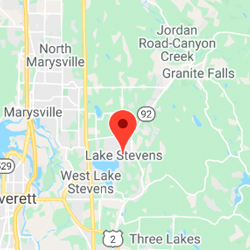
Lake Stevens
(
)
+1
-
Population41,000
-
VC Rate 2026, 2025, 20241.1, 1.1, 1.6
-
PC Rate 2026, 2025, 20247.2, 8.7, 11.0
-
VC=Violent crime, PC=Property crime
#10
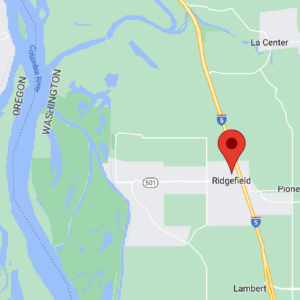
Ridgefield
(
)
+1
-
Population16,769
-
VC Rate 2026, 2025, 20240.8, 1.2, 1.0
-
PC Rate 2026, 2025, 202411.4, 10.7, 12.8
-
VC=Violent crime, PC=Property crime
From rankings to real-world safety
Our Safest Cities rankings help highlight crime incidence patterns and relative risk — but they don’t determine what happens in a community or a home. How safe a community is (or isn't) is the result of a mix of individual choices, community conditions, and external factors like the economy, job market, housing availability, and local priorities.
Expand the sections below for a closer look at what you can do to help improve the safety of your community.
It's not possible to eliminate risk entirely, but you can reduce your potential risk by staying informed about local crime trends, practicing situational awareness (know who belongs in your neighborhood, work parking lot, etc.), and taking practical steps to protect yourself and your property.
Getting involved in your community can make a big difference — but you should expect certain baseline crime prevention measures from your neighborhood and city.
- Good lighting in public spaces
- Visible community law enforcement presence
- Neighborhood watch-type groups/support
- Access to a community liasion officer or department
- Budget to support community safety programs (beyond law enforcement)
Strong local networks — whether formal or informal (or in-person or virtual) — can play an essential role in improving safety beyond what statistics alone can capture.
Our research and national crime data consistently point to the value of layered prevention. This means that the more layers you put between your home and loved ones and criminals, the better chance you have of actually deterring a criminal act.
Multiple security layers can look like a neighborhood watch plan combined with locking your doors when you leave the house, and a security camera with a siren that can scare an intruder away. A monitored security system that connects you to faster help if something happens adds an extra proactive layer.
Research-backed practices that help reduce exposure include:
- Community prevention: Improved lighting, clear sightlines (trim hedges and bushes near doors/windows), and coordinated neighborhood efforts
- Awareness and reporting: Stay alert, trust your instincts, know who and what belongs in your neighborhood, and report suspicious behavior
- Home safety fundamentals: Secure all entry points (don't forget the deck or the sliding glass door), eliminate hiding spots around your home, and get into consistent security routines (locking the door, arming the security system)
- Targeted technology use: Pair common-sense safety habits with tools that support awareness or response, like monitored security systems or cameras
- Explore our safety research
- See crime trends by state
- Learn more about home security essentials
How we determine and interpret these rankings
Our Safest Cities rankings offer a data-informed look at crime trends across cities. They’re designed to highlight relative risk — not to define overall quality of life or what it’s like to live in a community.
We use the most recent FBI-reported violent and property crime data, and adjust for population so we can compare cities of different sizes fairly. This approach helps us identify patterns and differences in reported crime rates.
Our analysis includes only crime data from agencies that submitted complete reports to the FBI through the National Incident-Based Reporting System (NIBRS). We do not estimate crime totals for agencies with incomplete reporting, so our findings and crime rate trends may differ from reports that include estimated national crime data.
We understand that crime statistics reported to one source don’t tell the whole story. A number of factors, including local agency reporting practices, community resources, prevention efforts, and lived experience all influence how safe a place is (or is perceived to be) — and not all of that shows up in the numbers.
Think of these rankings as a starting point. Our goal is to help readers understand crime trends and ask informed questions, not to judge communities or the people who call them home.
Learn how we identified the safest cities on our methodology page.
Get a deeper understanding of our independent research, data sources, calculations, and how we refine our reports each year.
Related articles on SafeWise
Endnotes and sources
Find all endnotes and sources in our full methodology.
FBI Crime Data Explorer, "Documents & Downloads."
- 2024 Crime in the United States Annual Reports
- Offenses Known to Law Enforcement
- 2024 NIBRS Estimation Tables
Bureau of Justice Statistics, "National Incident-Based Reporting System (NIBRS)."
Gun Violence Archive, "Mass Shootings."
Safest Cities Badges:
Safest Cities badges are available at no charge for use by law enforcement agencies and city government. City government and law enforcement representatives should contact [email protected]
to inquire about badge usage.
To request a badge:
- Please put "Safest Cities badge request" in your subject line
- Include the name of your city and state
- Share the city government or law enforcement agency you represent
Badges are also available for licensing by other entities, including tourism boards, local businesses, and similar organizations. All other interested parties should contact our official partner, Wright’s Media, for information on available usages, license fees, and award seal artwork at [email protected].


Recent Articles

The Best Fall Detection Devices
Find the best medical alert systems with fall detection. Compare equipment, price, accuracy, customer reviews,...

Jury Finds Meta and YouTube Negligent in Landmark Social Media Addiction Case
Meta and YouTube were found negligent in a landmark addiction case. Here’s why it matters...
How Safe Are the Fastest-Growing U.S. Cities?
Does a surge in population lead to a surge in crime? Find out in our...
Package Theft and Cybercrime Are Now the Most Common Crimes in America
State of Safety data shows Americans are more likely to experience package theft and cybercrime...


