

100 Safest Cities in the U.S.

For over 13 years, SafeWise experts have conducted independent research and testing to write unbiased, human reviews (not robots). Learn more.

Cathy Habas
Feb 23, 2026
Icon Time To Read5 min read
Icon CheckData Analysis ByDaniel Delgado
Icon CheckEdited ByRebecca Edwards

Cathy has been a SafeWise contributor since 2021, helping turn crime data into clear, useful safety insights.

2026 Editor's Note

Now in its 12th year, the SafeWise Safest Cities report remains one of the most comprehensive annual comparisons of per capita crime rates in the U.S.

This year’s rankings are based on the most recent FBI crime data available (covering calendar year 2024). While national violent crime rates have declined in many areas, trends vary widely across states and cities. As always, our rankings focus strictly on reported violent and property crime rates per capita to provide a standardized comparison across communities.

Despite FBI reports that crime across the US is declining, many Americans still feel that crime is on the rise. In fact, only 16% of our State of Survey respondents agree that crime is decreasing—and only about half (52%) said they felt safe in their home state in 2025.

But plenty of cities remain relatively immune to crime trends and headlines that often plague America’s larger metro areas. The 100 cities and towns that made our list this year reported drastically lower per-capita crime rates than nationwide averages, collectively coming in at 0.2 incidents per 1,000 people (on average) for violent crime and a collective average of 2.2 incidents per 1,000 for property crime.

Comparatively, the US violent crime rate, as calculated by our data analyst, is 4.43 incidents per 1,000 people, while the property crime rate is 22.89 incidents per 1,000.

Curious about cities in your state? Check out the safest cities in every state report.

Here are the 10 Safest Cities in America for 2026

See if your city made the full list.


In this report


Icon Quote  Dark
Why is Shawangunk, NY considered the safest city in America when it's not on SafeWise's list of safest cities in New York?

Great question! It has to do with the unique population thresholds we use in each report, which are calculated using the state's median population — or in this case, the nation's median population. To qualify for ranking, a city's population must be higher than the median population. Some cities' populations are too low to qualify for their state list but high enough for the national list, or vice versa.

When cities report crime data to the FBI, they also share their population at the time of the report. We use these population statistics to calculate the median population for each state. To qualify for ranking on our safest cities pages, a city must have a population equal to or greater than the median population in its state. This reduces the risk of outliers and lowers the likelihood of an extreme outlier skewing the data.

For example, the median population for the state of New York is 14,727. Shawangunk, NY has a population of 13,376, which is lower than the median population for New York. This means Shawangunk is ineligible for ranking on our list of the safest cities in New York.

To create the list of 100 safest cities in America, we applied the same population threshold methodology to the entire nation. According to FBI population data, the median population of all US cities is about 6,800. Therefore, Shawangunk qualifies for ranking in this nationwide list.

(Because every city in a state may not report to the FBI, a state's total population may not be accounted for, and the median population we determine is likely different than a median based on U.S. Census data.)

Learn more about our Safest Cities methodology.


Breaking down the safest cities: Why crime rates aren't the whole story

Crime rates and other statistics give us one way to measure "safety" across cities, but this data only scratches the surface. Safety can't be reduced to numbers alone, which don't account for factors like how secure people feel in their communities, access to resources, and the underlying social and economic conditions that influence crime and safety.

One of the biggest challenges in ranking safe cities is that we rely on self-reported FBI crime data, which only captures certain aspects of public safety. It doesn't reflect issues like racial and economic disparities or even the impact of sudden policy changes — like deportations, or shifts in law enforcement priorities — that can make communities feel more or less safe.

This ranking of the 100 safest cities in the U.S. relies on self-reported crime data from law enforcement agencies across the country. It's the most comprehensive dataset, covering the most cities and towns, but it uses only one dimension of safety. Our intention is to get people thinking about safety, jump-start conversations, and inspire action in big and small cities, regardless of their per capita crime rates.

Jump to our tips to better evaluate safety in your community and help make a difference.


The 100 safest cities in the U.S.

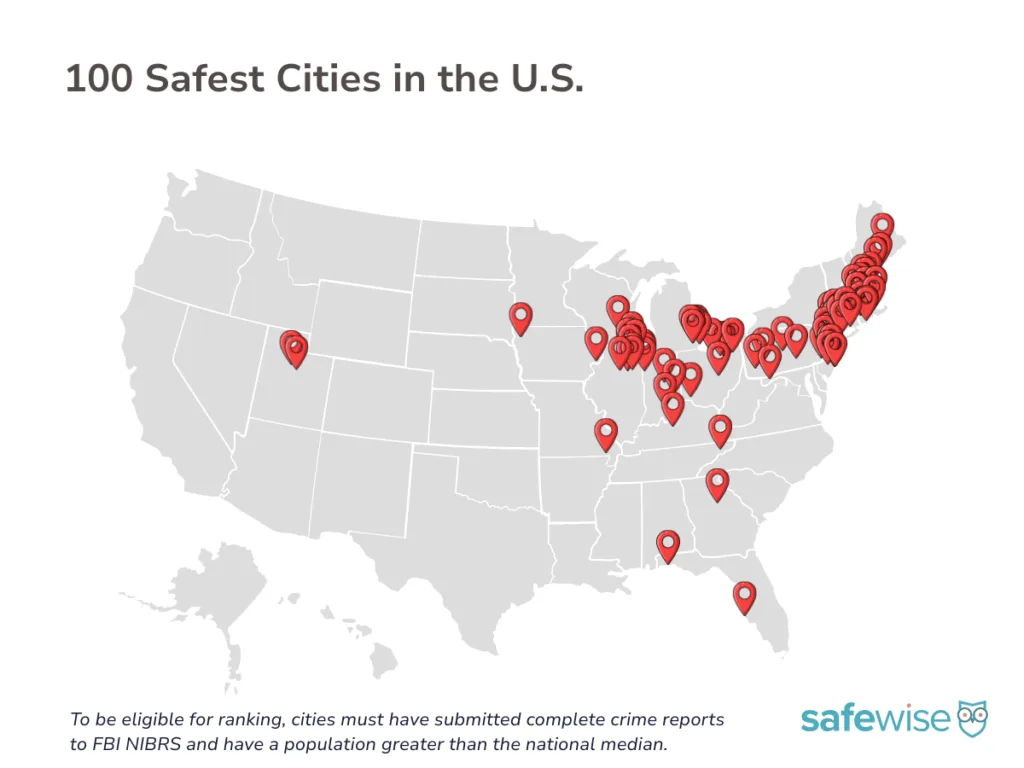
A map of the safest cities in the U.S. Most are clustered in the Boston, New York City, and Philadelphia corridor, as well as around Cleveland, Chicago, and Detroit. Image: SafeWise


A closer look at the safest cities in the US

For the purposes of this report, the terms “dangerous” and “safest” refer explicitly to crime rates as calculated from FBI crime data—no other characterization of any community is implied or intended.

While there’s no one thing that indicates if a city will report higher or lower numbers of crimes, we’ve noticed some things that stand out about the 100 cities on our list. Here’s a rundown of some of the most interesting factors we’ve uncovered during our analysis.

Crime insights 

  • The violent crime rate among the safest cities is 0.2 incidents per 1,000 people—that’s about 96% lower than the national rate of 4.43.
  • The property crime rate among the safest cities is 2.2 incidents per 1,000—that’s 90% lower than the national rate of 22.89.
  • Only 1 city reported 10 or more total violent crimes, and 18 reported zero.
  • 83% of the cities reported fewer than 50 total property crimes. 
  • 96% of the cities had no murders reported, including the two largest cities on the list: Columbus, Indiana, and Hampden Township, Pennsylvania.
  • 14 cities reported zero burglaries, and only 1 saw more than 40.
  • 13 of the 100 safest cities are the number one safest city in their state: CT, IL, IN, IA, ME, MD, MA, NJ, NY, OH, PA, RI, and UT.

Demographic insights 

  • Shawangunk, NY is the safest city in the U.S. for 2026.
  • New Jersey leads the way with 17 cities making the list, the most of any state.
  • 21 states are represented, 4 fewer than last year.
  • The average population of the safest cities is 13,995—showing that safety isn’t limited to just small towns.
  • Eldridge, Iowa, is the smallest city on the list, with a population of 6,886.
  • Columbus, Indiana, is the largest city on the list, with 51,867 residents—significantly larger than most other cities in the top 100.

The 100 safest cities in America

VC= Violent crime, PC=Property crime; Crime rates per 1,000 people; Median household income

Shawangunk Town, NY, 17th safest city in America for 2025.
#1
Shawangunk, NY
  • Circle Population
    Population
    13,376
  • Circle Gun
    VC Rate 2026
    0.0
  • Circle Property
    PC Rate 2026
    0.4
Train station in Emerson, New Jersey
#2
Emerson, NJ
  • Circle Population
    Population
    7,402
  • Circle Gun
    VC Rate 2026
    0.0
  • Circle Property
    PC Rate 2026
    0.9
Campton Hills, IL, the safest city in America for 2025.
#3
Campton Hills, IL
  • Circle Population
    Population
    10,768
  • Circle Gun
    VC Rate 2026
    0.1
  • Circle Property
    PC Rate 2026
    0.5
#4
Chester, NY
  • Circle Population
    Population
    8,608
  • Circle Gun
    VC Rate 2026
    0.1
  • Circle Property
    PC Rate 2026
    0.3
#5
Allendale, NJ
  • Circle Population
    Population
    6,926
  • Circle Gun
    VC Rate 2026
    0.0
  • Circle Property
    PC Rate 2026
    1.2
#6
Upper Makefield Township, PA
  • Circle Population
    Population
    8,818
  • Circle Gun
    VC Rate 2026
    0.0
  • Circle Property
    PC Rate 2026
    1.2
Great Egrets in Hawthorn Woods, IL, the third-safest city in America for 2025.
#7
Hawthorn Woods, IL
  • Circle Population
    Population
    9,470
  • Circle Gun
    VC Rate 2026
    0.0
  • Circle Property
    PC Rate 2026
    1.3
Broadview Heights, OH, 12th safest city in America for 2025.
#8
Broadview Heights, OH
  • Circle Population
    Population
    19,709
  • Circle Gun
    VC Rate 2026
    0.1
  • Circle Property
    PC Rate 2026
    1.0
#9
Millis, MA
  • Circle Population
    Population
    9,370
  • Circle Gun
    VC Rate 2026
    0.1
  • Circle Property
    PC Rate 2026
    0.9
Boxford, MA, 10th safest city in America for 2025
#10
Boxford, MA
  • Circle Population
    Population
    8,291
  • Circle Gun
    VC Rate 2026
    0.0
  • Circle Property
    PC Rate 2026
    1.4
#11
Columbus, IN
  • Circle Population
    Population
    51,867
  • Circle Gun
    VC Rate 2026
    0.1
  • Circle Property
    PC Rate 2026
    0.8
#12
Atkinson, NH
  • Circle Population
    Population
    7,434
  • Circle Gun
    VC Rate 2026
    0.1
  • Circle Property
    PC Rate 2026
    0.9
#13
Frostburg, MD
  • Circle Population
    Population
    6,946
  • Circle Gun
    VC Rate 2026
    0.1
  • Circle Property
    PC Rate 2026
    1.0
Chesterfield Township, New Jersey
#14
Chesterfield Township, NJ
  • Circle Population
    Population
    9,299
  • Circle Gun
    VC Rate 2026
    0.2
  • Circle Property
    PC Rate 2026
    0.8
Vernon Township, NJ, 9th safest city in America for 2025.
#15
Vernon Township, NJ
  • Circle Population
    Population
    22,851
  • Circle Gun
    VC Rate 2026
    0.0
  • Circle Property
    PC Rate 2026
    1.7
Eliot, ME, the eighth-safest city in America for 2025.
#16
Eliot, ME
  • Circle Population
    Population
    7,511
  • Circle Gun
    VC Rate 2026
    0.0
  • Circle Property
    PC Rate 2026
    2.0
Pingree Grove, IL, the second-safest city in America for 2025.
#17
Pingree Grove, IL
  • Circle Population
    Population
    11,395
  • Circle Gun
    VC Rate 2026
    0.1
  • Circle Property
    PC Rate 2026
    1.6
#18
Litchfield, NH
  • Circle Population
    Population
    8,514
  • Circle Gun
    VC Rate 2026
    0.1
  • Circle Property
    PC Rate 2026
    1.5
Weston, CT, 19th safest city in America for 2025.
#19
Weston, CT
  • Circle Population
    Population
    10,353
  • Circle Gun
    VC Rate 2026
    0.0
  • Circle Property
    PC Rate 2026
    2.2
#20
Lincoln, MA
  • Circle Population
    Population
    6,985
  • Circle Gun
    VC Rate 2026
    0.0
  • Circle Property
    PC Rate 2026
    2.3

Didn't find your city in the top 20?

We calculated crime rates for every city in the country that submitted complete crime reports and met our population threshold. See how the remaining cities ranked in the list below. 

NOTE: If you don’t see your city on the list, it means that it was below the population threshold or didn’t submit a complete crime report to the FBI in the last year for which complete data was available at time of publication.

National rank
City or Agency
State
Population
Violent crime rate Icon Tooltip  Dark
Property crime rate Icon Tooltip  Dark
21Bernards TownshipNew Jersey28,9210.11.8
22Grosse Ile TownshipMichigan10,2960.02.4
23NorthboroughMassachusetts15,9750.11.9
24St. JohnIndiana24,7900.21.3
25Cape ElizabethMaine9,6100.21.7
26CumberlandMaine8,8450.02.8
27MarlboroughNew York8,8260.02.9
28WolcottConnecticut16,3790.21.7
29ClintonMassachusetts15,8640.40.7
30Spring Township, Centre CountyPennsylvania8,0570.41.1
31North Hanover TownshipNew Jersey8,0240.41.1
32OronoMaine12,6410.41.0
33UptonMassachusetts8,5750.31.3
34Western SpringsIllinois13,1910.12.7
35Olmsted FallsOhio8,6380.03.1
36GlocesterRhode Island10,4270.41.2
37HarvardMassachusetts7,0860.31.7
38WindhamNew Hampshire16,1580.22.2
39RyeNew York16,0940.12.5
40Sioux CenterIowa8,6430.50.8
41Lone Peak (Alpine and Highland)Utah30,8120.31.7
42Oakland TownshipMichigan20,3060.31.7
43HollistonMassachusetts15,3090.32.0
44ScituateMassachusetts19,7350.41.2
45LindenhurstIllinois14,3270.31.5
46LowellIndiana11,4220.32.0
47MerrimackNew Hampshire29,6500.03.4
48ReddingConnecticut8,7160.12.9
49BristolRhode Island22,2620.32.1
50SandwichIllinois7,2120.12.8
51BrecksvilleOhio14,0450.13.1
52Genoa TownshipOhio28,0850.12.8
53Cecil TownshipPennsylvania15,2060.32.2
54South RiverNew Jersey16,2370.51.0
55Hampden TownshipPennsylvania35,5760.22.4
56RockportMassachusetts7,1200.41.4
57RingwoodNew Jersey11,6230.31.8
58Hamburg TownshipMichigan21,1430.31.9
59MinookaIllinois12,9190.13.3
60Homer GlenIllinois24,5600.22.8
61SalemUtah11,2130.13.2
62DumontNew Jersey18,7650.22.9
63Olmsted TownshipOhio14,5350.31.9
64MadeiraOhio9,4000.03.7
65WanaqueNew Jersey11,2130.41.9
66MadisonConnecticut17,4580.22.9
67Bedford TownNew York16,1960.22.5
68ManhattanIllinois10,9120.41.9
69Poplar BluffMissouri16,1080.32.2
70HollisNew Hampshire8,8460.13.3
71GilbertsIllinois8,9090.32.1
72StrathamNew Hampshire7,7760.13.2
73Gulf BreezeFlorida6,9910.13.1
74Scarsdale VillageNew York17,6020.13.6
75Avon LakeOhio26,1670.22.9
76BatesvilleIndiana7,4030.13.2
77AuburnGeorgia10,5270.04.0
78ZionsvilleIndiana33,1210.22.9
79OconomowocWisconsin18,8300.23.2
80KinnelonNew Jersey10,2500.13.5
81Mayfield HeightsOhio19,7920.23.0
82RidgefieldConnecticut24,9240.22.8
83DyerIndiana16,2780.13.4
84Indiana TownshipPennsylvania7,2840.51.2
85Barnegat TownshipNew Jersey26,7130.60.8
86BarringtonNew Hampshire9,6250.23.0
87EldridgeIowa6,8860.13.3
88PitmanNew Jersey9,1050.23.0
89Ocean Township, Ocean CountyNew Jersey9,3140.23.0
90Argentine TownshipMichigan6,9650.61.1
91MountainsideNew Jersey7,0530.13.4
92Longboat KeyFlorida7,4840.04.1
93Lyon TownshipMichigan26,0940.32.8
94Church HillTennessee7,3110.32.7
95OradellNew Jersey8,3540.51.7
96PortsmouthRhode Island17,5790.13.6
97Vine GroveKentucky7,0110.32.7
98PortlandConnecticut9,4490.04.2
99La SalleIllinois9,3890.51.5
100GrotonMassachusetts11,4870.42.0

Get involved: Tips to help you research the safety of your community

Whether or not your city ranks high or low for per capita crime rates, there's a lot you can do to get a better grasp on how safe your neck of the woods really is. Stop wondering and start learning with these tips to find out more about what's happening in your neighborhood or city and how you can get involved.

  • Take a look outside: Paying attention to your street or neighborhood can tell you a lot. Some things to look for that can make a neighborhood safer include: street lighting, safe walking and biking paths/lanes, access to emergency services, fire hydrants, clean sidewalks, roads, and parks.
  • Check out online tools: There are safety apps and websites that offer things like real-time crime data and neighbor-shared concerns. These apps and sites also offer community resources for public safety, emergency responders, community programs and education, and other risks like natural disasters.
  • Get involved with your community: Talk to neighbors, go to city council and school board meetings, and keep an eye on local and national policies that can impact your safety. Learn about how budgets (is public safety funded adequately?) and community resources can contribute to or detract from safety trends and security. Join or start neighborhood safety programs to advocate for things like better street lighting, safer sidewalks during winter months, etc.

From rankings to real-world safety

Our Safest Cities rankings help highlight crime incidence patterns and relative risk — but they don’t determine what happens in a community or a home. How safe a community is (or isn't) is the result of a mix of individual choices, community conditions, and external factors like the economy, job market, housing availability, and local priorities.

Expand the sections below for a closer look at what you can do to help improve the safety of your community.

It's not possible to eliminate risk entirely, but you can reduce your potential risk by staying informed about local crime trends, practicing situational awareness (know who belongs in your neighborhood, work parking lot, etc.), and taking practical steps to protect yourself and your property.

Getting involved in your community can make a big difference — but you should expect certain baseline crime prevention measures from your neighborhood and city.

  • Good lighting in public spaces
  • Visible community law enforcement presence
  • Neighborhood watch-type groups/support
  • Access to a community liasion officer or department
  • Budget to support community safety programs (beyond law enforcement)

Strong local networks — whether formal or informal (or in-person or virtual) — can play an essential role in improving safety beyond what statistics alone can capture.

Our research and national crime data consistently point to the value of layered prevention. This means that the more layers you put between your home and loved ones and criminals, the better chance you have of actually deterring a criminal act.

Multiple security layers can look like a neighborhood watch plan combined with locking your doors when you leave the house, and a security camera with a siren that can scare an intruder away. A monitored security system that connects you to faster help if something happens adds an extra proactive layer.

Research-backed practices that help reduce exposure include:

  • Community prevention: Improved lighting, clear sightlines (trim hedges and bushes near doors/windows), and coordinated neighborhood efforts
  • Awareness and reporting: Stay alert, trust your instincts, know who and what belongs in your neighborhood, and report suspicious behavior
  • Home safety fundamentals: Secure all entry points (don't forget the deck or the sliding glass door), eliminate hiding spots around your home, and get into consistent security routines (locking the door, arming the security system)
  • Targeted technology use: Pair common-sense safety habits with tools that support awareness or response, like monitored security systems or cameras

Find the safest cities in each state

Click on the state below to check out the safest cities for each state.

How we determine and interpret these rankings

Our Safest Cities rankings offer a data-informed look at crime trends across cities. They’re designed to highlight relative risk — not to define overall quality of life or what it’s like to live in a community.

We use the most recent FBI-reported violent and property crime data, and adjust for population so we can compare cities of different sizes fairly. This approach helps us identify patterns and differences in reported crime rates.

We understand that crime statistics reported to one source don’t tell the whole story. A number of factors, including local agency reporting practices, community resources, prevention efforts, and lived experience all influence how safe a place is (or is perceived to be) — and not all of that shows up in the numbers.

Think of these rankings as a starting point. Our goal is to help readers understand crime trends and ask informed questions, not to judge communities or the people who call them home.

Learn how we identified the safest cities on our methodology page.

Get a deeper understanding of our independent research, data sources, calculations, and how we refine our reports each year.

Find all endnotes and sources in our full methodology.

FBI Crime Data Explorer, "Documents & Downloads." 

  • 2024 Crime in the United States Annual Reports
    • Offenses Known to Law Enforcement
  • 2024 NIBRS Estimation Tables

Bureau of Justice Statistics, "National Incident-Based Reporting System (NIBRS)." 

Gun Violence Archive, "Mass Shootings." 

Safest Cities Badges:
Safest Cities badges are available at no charge for use by law enforcement agencies and city government. City government and law enforcement representatives should contact [email protected]
to inquire about badge usage. Please put "Safest Cities badge request" in your subject line.

Badges are also available for licensing by other entities, including tourism boards, local businesses, and similar organizations. All other interested parties should contact our official partner, Wright’s Media, for information on available usages, license fees, and award seal artwork at [email protected].

Cathy Habas
Written by
With over 12 years of experience as a content writer, Cathy has a knack for untangling complex information. Her natural curiosity and ability to empathize help Cathy offer insightful, friendly advice. She believes in empowering readers who may not feel confident about a purchase, project, or topic. Cathy earned her Bachelor of Arts degree in English from Indiana University Southeast and began her professional writing career immediately after graduation. She is a certified Safe Sleep Ambassador and has contributed to sites like Safety.com, Reviews.com, Hunker, and Thumbtack. Cathy’s pride and joy is her Appaloosa “Chacos.” She also likes to crochet while watching stand-up comedy specials on Netflix.

Recent Articles

Tracki GPS Tracker Review
We review the Tracki GPS Tracker—a compact, versatile device ideal for tracking children, vehicles, and...
BoT Talk Review
The BoT Talk offers voice messaging, GPS tracking, and geofencing without the temptation of a...
Tack GPS Tracker Review
The budget-friendly Tack GPS tracker works in 120 countries and costs just $3 to $7...
mother walking kid to school
Best GPS Trackers and Tracking Devices for Kids in 2026
We tested 2026's best wearable GPS tracking devices designed to keep your child within reach...